Ankle Exoskeleton

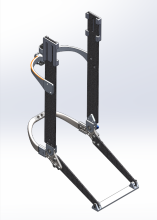
Our project aims to develop a lightweight and modular ankle exoskeleton to assist stroke patients in rehabilitation. Existing solutions are often bulky, difficult to use, and not adaptable to various shoe sizes. Our design integrates a quick-release mechanism to ensure easy, equipping and donning off, improving user experience for patients and physical therapists. The exoskeleton will provide supportive yet lightweight force assistance, enhancing mobility without adding excessive strain.

Firefly

Background

This project focuses on the development of an autonomous drone system designed to survey an area, detect wildfires or fire outbreaks, and intervene with fire retardant to mitigate the spread of flames. The drone is equipped with sensors and cameras, to identify fire hotspots in real-time. Using color-filtering algorithms in addition to sensors, the system can accurately distinguish between fire and non-fire events, ensuring high precision in detection.

Resilient Mobile Space Launch System

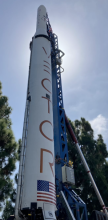
We are designing a mobile rocket launch system that can be transported across all U.S. highways, complying with Department of Transportation regulations in every state. The system consists of two main subsystems: the Transporter, Erector, Launcher (TEL) and the launch vehicle (rocket). The TEL includes a hydraulic erector system capable of lifting the rocket to a full 90 degrees while providing full support with a strong back. The launch vehicle can deliver a minimum 200 lb payload to a 500 km polar orbit (270 Nmi/Polar) and features a reusable first stage designed to land on any surface after launch. The rocket will use existing models of rocket engines and will be powered by liquid propellants. The launch platform will secure the rocket during the initial launch at 100% thrust utilizing a ground drilling mechanism. The entire system can be fully set up within 8 hours of arriving at the launch site. This mobile launch system can be deployed anywhere across America, which eliminates the limitations of being confined to the two current launch sites in Vandenberg, California, and Kodiak, Alaska.


ZotQuatics

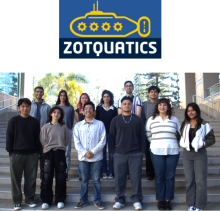
ZotQuatics Logo and Goup Photo

About Us
The UC Irvine ZotQuatics team works towards designing and manufacturing an Autonomous Underwater Vehicle (AUV) to compete in the annual RoboSub Competition hosted by RoboNation. Teams from around the world come together to test their AUVs through a series of underwater objectives and present their work through technical documentation. Our AUV will also have applications in environmental remediation.

Our ultimate goal for 2024-25 is to establish ZotQuatics as a permanent pillar of the UCI Engineering community. We will do this by designing and fabricating Mark I of the ZotQuatics AUV as a platform for future teams to build off on and evolve. The Mark I shall adhere to RoboSub regulations regarding functionality, performance, constraints, and design attributes we identify to meet these requirements.

BoardBox — Anti-Theft Device for Personal Electric Vehicles

Summary:

Our project focuses on enhancing the security and storage of personal electric vehicles (PEVs) on campus. With rising theft rates of electric scooters and skateboards, as evidenced by UCIPD reports, students often bring their PEVs into lecture halls, violating fire codes and causing unnecessary congestion. Existing campus infrastructure lacks a secure and convenient solution, creating frustration for students and faculty alike.

To address this issue, we propose a secure locker system called BoardBox that allows students to temporarily store their PEVs using a mobile application. These lockers will feature a sophisticated locking mechanism—a multi-surfaced, linear-sliding, servo-powered system—along with integrated charging through solar panels and mobile phone compatibility. By providing a safe storage option, our system could encourage greater use of PEVs, alleviating campus parking challenges and promoting sustainable transportation. Additionally, this project presents an opportunity for the university to enhance campus amenities while exploring potential revenue streams.

Anteater Dynamics

Anteater Dynamics is a mechanical engineering senior design project team working with the robotics company ROBOTIS to design a low-cost 7-degree-of-freedom robotic arm targeted for personal robotics enthusiasts, capable of collecting data to be used in machine learning. The final product should be under $1000 to fulfill ROBOTIS’ vision of easily accessible robot technology.

Wheel of Whatever I Want

The purpose of the project is to create a wheel spinner that can be secretly manipulated by the user. The spinner will land on any specified section of the wheel, smoothly enough that the selection appears to be natural, and the manipulation can’t be detected by anyone unaware of the wheel’s mechanical properties.

BAJA Powertrain Driveline

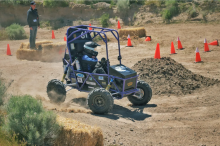
Image of Baja vehicle on the dirt track at competition

Background

BAJA SAE is a national collegiate competition that is held every year which includes a hill climb event, endurance race and obstacle course. In the past, our team has experienced technical and driver issues, resulting in incompletion of the race. This year, the goal is to finish and place in the top 20. 

Goals and Objectives

Robotic Playground Swing

SwingCraft is our project in which we will research, design, and fabricate an autonomous robotic swing that demonstrates the principles of parametric resonance and conservation of angular momentum. Starting from an initial displacement, the swing will be able to autonomously increase its amplitude by effectively lengthening and shortening the length of its pendulum/swing. By correctly timing the length changes of the swing, energy can be pumped into the system resulting in an increasing amplitude. Much like how a child on a swing uses their legs to increase the amplitude of their swinging motion, our design will utilize a double pendulum to mimic this motion. Our end goal is to have successfully designed a 1:10 scale model swing that can be used as a source of entertainmentthat which demonstrates parametric resonance.  

Equitable Design Solutions: Adjustable Backrest Attachment for Lab Stools

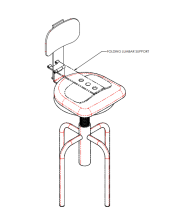
Isometric view of a Computer-Aided-Design model of the Adjustable Backrest secured onto a lab stool.

The Adjustable Backrest Attachment is designed to improve comfort and ergonomics for users of standard lab stools. By incorporating an adjustable height range of 4”–6”, the backrest provides essential lumbar support while accommodating different users’ needs. The stool mount ensures stability and durability, featuring thigh support, a rigid base for structure, and foam padding to distribute weight evenly and reduce tailbone pressure. The clamp mechanism allows for secure attachment while maintaining easy adjustability with minimal effort.

Pages