
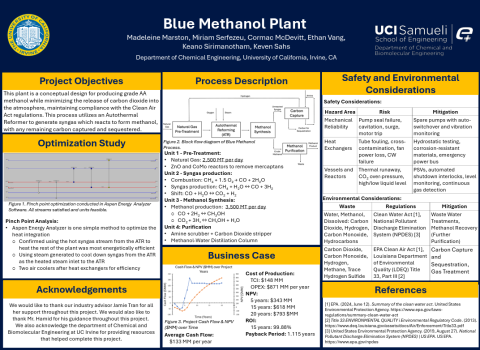
This report presents a technical and economic evaluation of a blue methanol plant designed to produce 3,500 metric tons per day of grade AA methanol with a product purity of 99.86%. The process consists of using natural gas feedstock, autothermal reforming, methanol synthesis, and carbon capture technologies to produce low-carbon methanol while achieving approximately 95% carbon dioxide emission capture. This complete technical package includes the development and design of the process, along with process simulation, equipment sizing, safety analysis, environmental considerations, and a techno-economic assessment.
The courses for the capstone projects in the Department of Chemical and Biomolecular Engineering (CBE 150 A/B) are run by .... and are offered during the winter and spring quarters.
CBE
2025-2026 - Spring
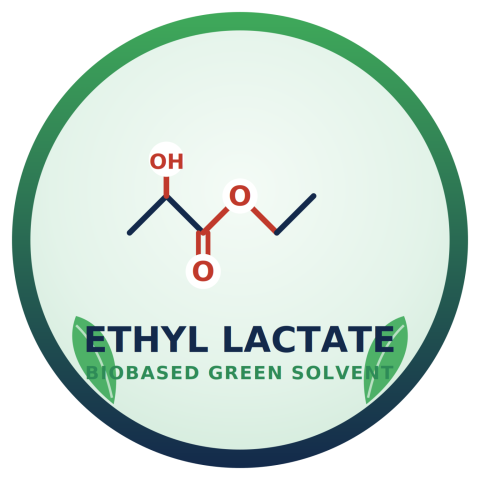
Ethyl Lactate - Commercial BioBased Green Solvent
Ethyl lactate is one of the few solvents that is fully renewable, biodegradable, and non-toxic while still performing like the petroleum-based solvents it can replace. Its low toxicity and skin-friendly profile make it valuable beyond industrial cleaning and coatings: it is used in pharmaceuticals as a green solvent for drug formulation, controlled drug delivery, and as a chiral building block in drug synthesis, and in cosmetics and personal-care products such as creams, lotions, and fragrances. Most conventional solvents, by contrast, come from petroleum and are often toxic, volatile, and environmentally persistent, posing risks to workers and a growing regulatory burden. This project designs a full-scale plant to produce ethyl lactate from renewable lactic acid and ethanol. The scope is the complete process design — reaction, separation, and purification to 99.9% purity — plus the heat-integration, environmental, safety, and economic analyses needed to judge whether the plant is technically sound...

CBE
2025-2026 - Spring
Green Ammonia Plant
Ammonia is a globally indispensable chemical commodity because it serves as the foundational building block for agricultural fertilizers. Without it, commercial farming operations could not sustain the food supply required for the general population. It is also becoming a vital, carbon-free energy carrier used to transport hydrogen cleanly across the world. Traditional "grey ammonia" relies on burning fossil fuels, like natural gas or coal, to extract the hydrogen needed for the process. Because this current method is so heavily dependent on hydrocarbons, it releases massive amounts of carbon dioxide, making the chemical industry a huge contributor to global greenhouse gas emissions. This project designs a "green ammonia" facility that completely eliminates fossil fuels from the production lifecycle. Instead of reforming hydrocarbons, the plant uses clean thermal and electrical energy from small modular nuclear reactors to power high-temperature steam electrolysis, splitting water into clean hydrogen. This hydrogen is then combined...

CBE
2025-2026 - Spring
Green Ammonia Plant
Ammonia is a widely used industrial chemical, primarily in fertilizer production, and is also gaining attention as a potential carbon-free energy carrier due to its high hydrogen content and established global distribution infrastructure. However, conventional ammonia production is heavily dependent on fossil fuels, particularly through steam methane reforming, which results in significant greenhouse gas emissions. As a result, there is growing interest in alternative low-carbon production pathways.
This project focuses on the design and simulation of a green ammonia production process powered by renewable electricity. Hydrogen is produced through water electrolysis and subsequently combined with nitrogen in a Haber-Bosch-based catalytic synthesis loop to produce ammonia. The objective of the work is to develop a technically consistent and economically evaluable plant design that can be used for preliminary investment assessment.

CBE
2025-2026 - Spring
Non-Alcoholic Beer Production
Non-alcoholic beer is a popular alternative to good ol' beer for people who are trying to kick their addiction, enjoy social events without getting drunk, or simply just enjoy the taste of beer. This project presents the design and techno-economic analysis of a non-alcoholic beer plant designed to produce 240 metric tonnes (MT) per day of non-alcoholic beer. The beer meets FDA requirements by being < 0.5% ABV. The beer production plant utilizes mashing, boiling, fermentation, and distillation to produce non-alcoholic beer. This project was estimated to have an initial investment of $11 MM, with a return on investment (ROI) of 1013% over the span of 10 years. Process simulations and safety, environmental, and economic analyses were performed to highlight the feasibility and profitability of non-alcoholic beer production.

CBE
2025-2026 - Spring
Sustainable Aviation Fuel (SAF) Production from Bio-Ethanol: Process Design and Techno-Economic Feasibility Assessment
Aviation is a major contributor to global climate change, accounting for approximately 2.5% of global CO₂ emissions and roughly 5% of total anthropogenic warming when non-CO₂ effects are included. Without intervention, aviation emissions are projected to double by 2050, yet Sustainable Aviation Fuel (SAF) currently represents only 0.2% of global jet fuel consumption. This project addresses the urgent need to scale up SAF production by designing and evaluating a commercially viable bio-ethanol-to-jet (ETJ) fuel process. The aviation industry, airlines, passengers, and the broader global community concerned with climate change are all directly affected, as are agricultural and biofuel producers who stand to benefit from an expanded market for bio-ethanol feedstocks. By demonstrating a technically sound and economically feasible pathway to produce low-carbon jet fuel, this project contributes to the decarbonization of one of the hardest-to-abate sectors in the global economy.