Daun Bot

We are designing a robot to collect solid samples for small gardens and greenhouses efficiently. Typically, soil sampling is done manually, which often results in inconsistent data. These inconsistencies lead to inaccurate information, limiting farmers' ability to manage their crops effectively. Our robot will collect composite samples made of smaller soil samples using an auger drill to penetrate the ground, extract the samples, and store them in a designated sample box. Additionally, it will feature multi-terrain wheels powered by four DC motors, allowing it to navigate various terrains with ease. This automation improves accuracy, efficiency, and overall crop management.

SnapVolt: Modular Low-Voltage Distribution Box

SnapVolt is a student-led project with the ambition to design, test, and prototype a low-voltage distribution box (fuse box) that is compatible across different electric vehicles. Inspired by current vehicles with fuse boxes that are unique to a particular model, our design will allow users to create different combinations of fuses and relays to match their personal vehicle. A priority of this project is to allow simple and tool free assembly and disassembly with snap in components, similar to Lego pieces. Additionally, SnapVolt aims to create a cost effective design with the intention of making the product competitive in the market.

Dyno Snatcher

In search and rescue operations, hazardous environments with debris and tangled wires often block access to critical areas. To address this challenge, we are developing a flexible, portable, remote-controlled claw to assist our quadruped robot, Dyno. This claw is designed to efficiently clear obstacles, ensuring a safer and more accessible path for responders and the robot.

Our solution focuses on enhancing Dyno’s capabilities in navigating and manipulating its environment, making it a versatile tool in high-risk situations. The RC claw features precise control for handling objects of varying sizes and complexities, all while maintaining portability for ease of deployment.

This innovative approach reduces the need for direct human intervention in hazardous zones, minimizing risk to personnel while improving the efficiency of search and rescue missions. By integrating this tool with Dyno, we aim to redefine robotic assistance in disaster response scenarios, prioritizing safety and adaptability in challenging environments.

BAJA SAE Powertrain

Baja Racing Logo

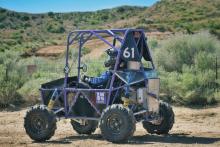
Baja SAE is a national colligate competition where teams compete to build and race an off-roading race vehicle. In this project the team is tasked to design, build, and test the powertrain subsystem of the 2025 Baja SAE vehicle. The powertrain subsystem must be capable of AWD by delivering power to all 4 wheels, as well as being lightweight and robust enough to make Anteater Racing a feared competitor. The proposed powertrain design features a fully custom transfer case, outputting to a driveshaft and front differential. Designs must adhere to all rules listed in the Baja SAE rulebook, while maintaining critical safety factors to prevent failures operating in extreme off-road conditions. The vehicle must be built and tested prior to the Arizona competition in May 2025. 

ZotCart Autonomous Golf Cart

ZotCart is a fully autonomous golf cart that will be roaming around Ring Road in the near future. This is achieved by designing drive, brake and steer by wire mechanisms to allow for autonomous control of the golf cart, with the ability for a human to take control in case of an emergency. Several sensors such as cameras, radars, and IMUs along with control algorithms will allow for autonomous driving around static obstacles.

Solar Car: Braking System

Background

The goal of UCI Solar Car is to build a solar car to compete in the Formula Sun Grand Prix (FSGP) to qualify for the American Solar Challenge (ASC). This will be our first time competing in the competition, and we plan to do so with a 3-wheel car. Our role in the brakes team is to complete the human interface components of the car which includes: parking brake, brake light switch indicator, dashboard, brake lines, and driver equipment


About ASC/FSGP

UCI RoboSub

UCI RoboSub Hull, including aluminum extrusion chassis, thrusters, and a torpedo launcher

The UCI RoboSub team designs an Autonomous Underwater Vehicle (AUV). Our AUV features autonomous localization, ultrasound detection, and a magnetically actuated appendage for the retrieval of debris off of the seabed. This project fosters innovation in underwater robotics, emphasizing autonomy, precision, and teamwork while addressing real-world maritime and environmental challenges.

Pages