FUSION Engineering Project: Remote-Controlled Precision Cargo Drone

FUSION Engineering Project Team Logos

The FUSION Engineering Project is a student-run engineering project that is managed by the club organization FUSION (Filipinx Undergraduate Scientists-Engineers In an Organized Network). The year-long project for the 2024-2025 academic year is a Remote-Controlled Precision Cargo Drone. This drone will have the capability to pick up a 2x2x2 in. wooden block and precisely deposit it at a landing zone. The drone will be controlled via remote control, and each team will implement their own creative designs including cameras, sensors, and other components to achieve this goal. At the end of the year, each team will use their drones to complete challenges in a competition. Each team will also be given the opportunity to present their work at our yearly conference FUSIONCon.

Anteater Formula Racing - Drag Reduction System

Background 

Anteater Formula Racing is a FSAE team at UCI that is dedicated to designing, building, and competing with an open-wheel, internal-combustion race car inspired by Formula 1 and IndyCar racing. The DRS project team is working closely with the Aerodynamics, Human Interface, and Electronics subteams within Anteater Formula Racing to design, test, and implement a drag reduction system on the existing rear wing of the vehicle, in order to improve race times and performance. 

Goal and Objectives 

Innovative Cold Plate

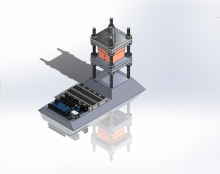
The cold plate heating apparatus, cold plate clamp, data collection and electronic control assembled

Background

The rapid growing field of AI and high-performance computing has led to small-form factor chips (CPUs/TPUs) with exceedingly high heat fluxes. Traditional air cooling struggles to dissipate these thermal loads efficiently. The research from our team at UC Irvine proposes an innovative liquid-vapor phase change cooling plate to address the need for high-performance cold plates that integrate seamlessly with new generation server hardware.


Goal and Objectives

The team seeks to accomplish the following:

Breathe Ez

Our project focuses on developing a breathing device that delivers controlled airflow while promoting a positive user experience. Designed with durability and scalability in mind, this device ensures long-term reliability and cost-effective manufacturing, making it both practical and accessible.

JellyfishBot

The UCI JellyfishBot team aims to develop a bioinspired underwater robot that mimics jellyfish movement for marine exploration within two academic quarters (Winter and Spring 2025). As the first project of its kind at UCI, the design features three subsystems: a linkage-based propulsion system, chassis, and electronic/control component. 

Coastal Currents

Coastal Currents Logo

The goal of our project is to design and develop a device that can be used by coastal residences to generate electricity utilizing the waves in the ocean. Approximately 71% of the earth's surface is water, making this a very promising and bountiful resource. Large scale wave energy generators are already in commission but are unfeasible to use for individual households. To accommodate small-scale power generation needs, Coastal Currents is developing a compact wave-energy generator that is intended for residential use on the coastline to provide power directly to homes by utilizing the energy and geometry of the ocean’s waves.

HeliCraft

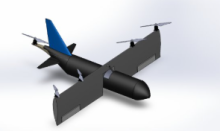
This project focuses on the design of a Tiltwing VTOL drone that combines fixed-wing efficiency with vertical takeoff and landing flexibility. The rotating wings enable smooth transitions between hover and cruise, improving maneuverability. The goal is stable flight, reliable performance, and payload capacity. The final design integrates aerodynamics and control systems into a compact, high-performance UAV.

Formula SAE Electric - Brakes

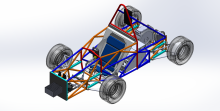
The brakes sub team aims to design a reliable and well-organized braking system for Anteater Electric Racing’s KiloZott, ensuring optimal performance, safety, and efficiency. To achieve this, the system will integrate regenerative braking to enhance energy recovery and feature configurable pedals for improved adaptability and driver preference. Whenever feasible, existing components will be incorporated to optimize cost and compatibility. A comprehensive CAD model will be developed prior to prototyping and assembly to ensure precision and minimize design iterations. This approach will result in an effective braking system that seamlessly integrates into the vehicle’s overall functionality, supporting the team's objectives in electric racing performance.

EV Driver Cockpit Subsystem Prototype

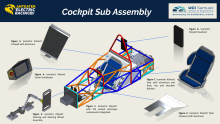
The Driver Cockpit Subsystem focuses on improving driver comfort, control, and safety in Kilozott, Anteater Electric Racing's newest car for the 2024-2025 season. The project includes the design, CAD modeling, and manufacturing of the seat, headrest, firewall, and steering system.

Testing revealed wrist strain from steering angles, inadequate lateral seat support, and inconsistent pedal resistance. To address these, the team is refining seat bolsters, steering ergonomics, and pedal feedback while ensuring seamless chassis integration.

Key improvements include a redesigned seat with extended bolsters, an optimized steering position, and an adjusted firewall for better helmet clearance. The team will finalize the prototype based on driver feedback and conduct static and dynamic testing before competition.

Autonomous Exploration

Our autonomous exploration rover is designed to navigate unknown environments with precision and efficiency. Equipped with a LiDAR scanner and IMU sensors, the rover creates detailed 3D maps and efficiently plans optimal paths to its destination. Using the RRT* (Rapidly-exploring Random Tree Star) algorithm, it navigates complex terrains while avoiding obstacles in real-time.

The rover’s advanced motion control system ensures smooth and accurate movement. Integrated with ROS (Robot Operating System) and built on the Waveshare JetRacer platform, the system delivers excellent performance and adaptability.

Designed for versatility, this autonomous rover has military applications with a powerful solution for exploring challenging environments safely and efficiently.

Pages