VRTDroneLogo
MAE 2025-2026 Winter
Spring
Internally Mentored (faculty, staff, TA)

VRTDrone - Hybrid VTOL Drone for Autonomous Sports Tracking

The VRTDrone team has been tasked with designing, manufacturing, and implementing a vertical takeoff and landing (VTOL) capable of autonomous flight in urban and confined environments. This project looks to address a need for a small aerial system capable of operating safely and reliably in confined or urban environments and support sports object-tracking-related tasks with minimal burden imposed on the operator. 

Analyzing sport gameplay often requires expensive tracking systems or manually operated cameras, limiting access for amateurs. As a result, many players and coaches lack affordable tools that can help to capture and analyze their respective sports during games and practices.

This drone could make game analysis much more accessible and efficient that currently possible helping users gain deeper insight into their matches. The primary groups affected include players, coaches, and analysts at an amateur level where professional tracking systems are often unavailable.

...
VRTDroneLogo
MAE 2025-2026 Winter
Spring
Internally Mentored (faculty, staff, TA)

VRTDrone | VTOL Senior Design Project

The increasing demand for autonomous video systems in sports analysis, broadcasting, and recreational activities has created a need for advanced platforms capable of dynamically capturing footage with minimal user input. Current camera and tracking systems are often limited in their ability to capture footage from multiple perspectives or require significant manual operation to function effectively. While drones provide a promising solution due to their ability to track fast-moving objects and capture unique aerial viewpoints, existing platforms have their own limitations. Conventional multirotor drones offer precise hovering and maneuverability but are constrained by limited flight endurance and coverage area. Conversely, fixed-wing aircraft provide greater speed, range, and efficiency but lack the ability to hover and operate effectively in confined environments.

To address these challenges, this project integrates computer vision, autonomous flight control, and hybrid VTOL (Vertical Takeoff and Landing) aircraft design to create a system capable of continuously...

Sumo Process Model
CEE 2025-2026 Winter
Spring
Industry Sponsored

Wastewater Reclamation Facility Expansion Project

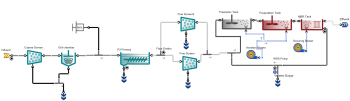
The expansion of this wastewater treatment plant involves the addition of a new wastewater treatment train capable of 10 MGD. During the process of evaluating the expansion alternatives, our team considered three methods of achieving this expansion: conventional activated sludge treatment, an MBR train, or the conversion of existing tanks to SBRs. Ultimately, KELG Consulting selected the MBR train because of the high effluent quality and low land usage, because we had to consider the site constraint of 550 by 170 ft. The MBR train consists of primary clarifiers, which leads to fine screening just upstream of the MBR. We chose to include these two pretreatments before the MBR to remove any solids upstream of the MBR to prevent fouling and damage within the aeration and membrane tanks. The MBR effluent is then directed to a chlorine contact basin where it receives a dose of chlorinee to provide residual...

Control Freaks
MAE 2025-2026 Fall
Winter
Competition/Extracurricular Project Sub-team

Wheel of Deception

The "Wheel of Deception" project, sponsored by Derek, addresses a gap in the professional entertainment market for compact, high-tech rigging hardware. Existing "off-the-shelf" rigged wheels are typically large, stationary floor units costing upwards of $10,000, making them difficult to transport and unsuitable for close-up environments like bar-top performances. The scope of this project was to engineer a portable, high-performance alternative that maintains all the functionality of a full-sized unit while fitting within a desktop footprint. This project matters because it provides a cost-effective, mobile solution for performers who require professional-grade mechanical deception in versatile, small-scale settings.

Anteater Airplane
MAE 2025-2026 Winter
Spring
Internally Mentored (faculty, staff, TA)

Wheelchair Accessibility in Commercial Aviation

Currently, commercial air travel lacks proper accommodations for wheelchair users and presents significant financial and emotional challenges for the individual during the duration of the trip. In 2023 alone, commercial airlines reported damaging or destroying 11,527 wheelchairs and mobility scooters (Smith). Because custom wheelchairs frequently cost upwards of $30,000 (BraunAbility), many wheelchair users report their reservations with flying. Coupled with the current boarding process requiring multiple physical transfers on and off their personal wheelchair, aisle chair, and airplane seat, wheelchair users lack autonomy and dignity throughout this experience. The statistics and lived experiences of wheelchair users point to a clear conclusion: there is a critical need for better accommodations for wheelchair users during air travel.

To address the critical shortcomings in wheelchair accessible air travel, our team has engineered a specialized solution designed to ensure the continuous comfort and safety of wheelchair users throughout their flight. To...

Zot & Go Transit Co.
CEE 2025-2026 Winter
Spring
Internally Mentored (faculty, staff, TA)

Zot N Go Transit Co.

Zot & Go Transit Co. conducted a traffic impact and intersection improvement project. This study is conducted at two intersections near UC Irvine, namely California Ave & Innovation Dr and California Ave & Academy Way. These intersections are chosen as they have a big impact as gateway access points for a proposed 2,500+ unit housing development near the UCI Research Park. This will create additional future traffic from a nearby cumulative research building project. The problem discussed in this project is that future growth is expected to increase all kind of traffics, including vehicle, pedestrian, and bicycle demand along California Ave. This will worsen congestion, delays, and intersection operations. The project is important because both intersections failed to achieve the minimum acceptable Level of Service D during future opening-year conditions. This will cause drivers, pedestrians, cyclists, UCI users, and nearby residents, to experience greater delay and reduced transportation efficiency.

Zot-onomous
MAE 2025-2026 Winter
Spring
Internally Mentored (faculty, staff, TA)

ZOT-ONOMOUS

Zot-onomous is a Senior Design Project focused on building an autonomous drone from the ground up. The goal is to design a student-built unmanned aerial vehicle (UAV) capable of vertical takeoff, forward flight, and a controlled rapid descent for accurate payload delivery. Most delivery drones descend slowly, noisily, and predictably. Zot-onomous takes a different approach: the drone climbs to 100 feet, then dives rapidly, safely pulling out of the descent 5 feet of the ground. This makes it faster, quieter, and harder to detect than conventional designs. That capability opens doors across three real-world applications: rushing medical supplies to hard-to-reach areas, supporting military logistics stealthily, and delivering packages to neighborhoods without the noise and privacy concerns drones typically bring. At its core, this project exists to move a 0.5 to 2 kg payload safely and reliably to its target. Onboard autonomy reduces human error and keeps every delivery consistent and repeatable.

ZOT-ONOMOUS
MAE 2025-2026 Winter
Spring
Competition/Extracurricular Project Sub-team

ZOT-ONOMOUS UAV Senior Design Project

Zot-onomous is a Senior Design Project which centers on the systems engineering and design of an autonomous unmanned aerial vehicle (UAV). The scope of the work involves creating a student-built drone capable of vertical take-off, transitioned cruise, and a rapid descent maneuver for precise payload delivery. This project addresses the critical need for a safe and operable vehicle that can transport a 2 kg payload, to target locations with minimal damage. By utilizing advanced autonomy, the design aims to reduce human error while ensuring the consistency and repeatability required for modern aerial logistics. The project is significant both as a practical solution for stable flight under moderate weather conditions and as an educational tool for the team to incorporate industry-standard systems engineering processes and documentation to a streamlined product.
 

Zpotless Robotic Arm Logo
EECS 2025-2026 Fall
Winter
Internally Mentored (faculty, staff, TA)

Zpotless

Litter and debris accumulation in outdoor pedestrian areas poses significant environmental, aesthetic, and economic challenges, driving up municipal maintenance costs while degrading public spaces used by communities daily. Zpotless addresses this problem by designing a fully autonomous, solar-powered cleaning robot capable of detecting, retrieving, and storing trash in outdoor public spaces with minimal human intervention. The system is built to be entirely self-sustaining by leveraging photovoltaic (solar) energy, eliminating dependence on external power infrastructure and enabling extended operation. This project matters because it targets a recurring, labor-intensive problem that affects residents, pedestrians, and facility managers in both residential and urban commercial environments.

Pages