
The expansion of this wastewater treatment plant involves the addition of a new wastewater treatment train capable of 10 MGD. During the process of evaluating the expansion alternatives, our team considered three methods of achieving this expansion: conventional activated sludge treatment, an MBR train, or the conversion of existing tanks to SBRs. Ultimately, KELG Consulting selected the MBR train because of the high effluent quality and low land usage, because we had to consider the site constraint of 550 by 170 ft. The MBR train consists of primary clarifiers, which leads to fine screening just upstream of the MBR. We chose to include these two pretreatments before the MBR to remove any solids upstream of the MBR to prevent fouling and damage within the aeration and membrane tanks. The MBR effluent is then directed to a chlorine contact basin where it receives a dose of chlorinee to provide residual disinfection, meeting title 22 requirements. In order to ensure that we properly designed this treatment, we followed benchmark examples in Metcalf & Eddy to obtain the key values for sizing. In addition to the hand calculations, we also prepared a simulation on SUMO Dynamita to gain insight on the plants performance utilizing both summer and winter simulations due to the temperature effects on air density and biomass growth. To complete our design package, the team created preliminary engineering drawings, as well as a project schedule and cost analysis to provide our client with essential knowledge for their project. In order to put this preliminary design into action, future work should consist of refining these plans with more detailed drawings and specifying equipment such as valves, pumps, and monitoring instruments.
Wastewater Reclamation Facility Expansion Project
Summary
Technical Approach/Methodology
As required by the client, three different expansion alternatives were researched based on the constraints and given regulatory requirements. The alternatives were: (1) the expansion of the existing secondary treatment, (2) a new parallel Membrane Bioreactor (MBR) train, and (3) the conversion of existing tanks to Sequencing Batch Reactor (SBR). KELG Consulting evaluated the three possible expansion alternatives and identified their advantages and disadvantages relative to the current WRF, ultimately deciding on implementing a new MBR train due to the high effluent quality & minimal required area.
The parallel MBR treatment train starts with the primary clarifier in order to remove most of the suspended solids and floatables. A total of 6 rectangular clarifiers will be used to maximize space efficiency.
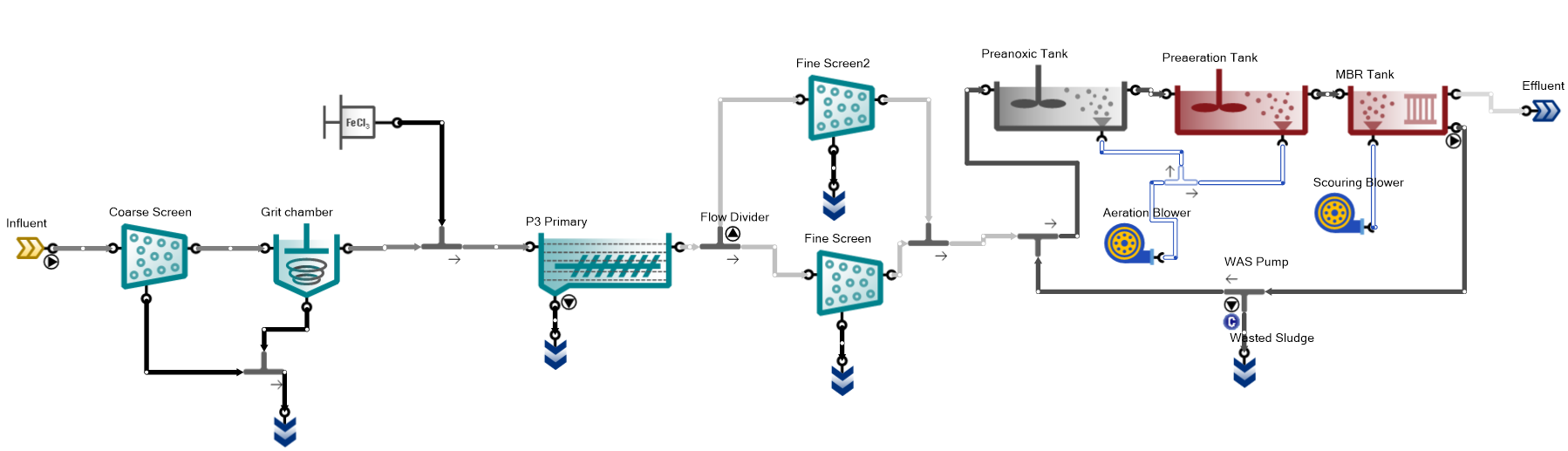
KELG Consulting used SUMO Dynamita to help visualize the layout of the new MBR treatment train within the existing facility. The model includes the parallel MBR Treatment train that contains primary clarifiers, two parallel fine screens, 6 MBRs supporting 10 MGD average flow, and a disinfection basin. It is important to note that the model does not show the complete number of clarifiers and basins for simplicity.
The disinfection basin includes the chlorine contact basin and the additional chlorine required to treat the 10 MGD expansion. The chemical feed systems and storage tanks for the chlorine will not be sized, since the existing units will connect to the new disinfection unit. In terms of design, the disinfection system will consist of plug-flow basins with a serpentine configuration and baffles that optimizes retention time. Moreover, a minimum of two disinfection basins is required for redundancy and reliability such that one can be put offline for cleaning, while the other remains in operation.
AUTOCAD Civil 3D was used to visualize the proposed treatment train and ensure that it would fit within our site constraints. Without considering the headworks and grit chamber which are located in another part of the treatment plant, our entire MBR train fits within the site.
Outcomes
The SUMO simulation model was proven to be functional through multiple simulations and achieves the effluent quality goals previously mentioned in regulatory requirements. The simulated concentrations of the parameters are significantly lower than the required values, showing very high quality effluent.
The SUMO process schematic was also simulated during the summer with the influent temperature of 83oF. The simulated effluent quality concentrations during the summer are significantly lower than the required values, meaning that the effluent is still of very high quality. This demonstrates that the proposed design meets both NPDES requirements and the goal of high quality effluent.
In addition, MLSS was an observed value to ensure that the system operates within regulatory standards and is operationally effective. The winter and summer simulations have MLSS values of 10,852 mg/L and 8,398 mg/L respectively. Both of these MLSS values are typical of an MBR system, which is required to be between 8,000 and 12,000 mg/L. Overall, the design has been proven to be effective as both winter and summer simulations ran smoothly.
The wastewater treatment expansion allows for community expansion, welcoming population growth to the area. Not only will this allow for more job opportunities in the area, but the new treatment train will require the addition of new employees at the treatment plant too, which is part of the operating and maintenance cost we defined above. This wastewater expansion project is important as it serves to handle the wastewater demands of the growing population in the city and the effluent will be used for indirect potable reuse by recharging a nearby groundwater aquifer, helping offset the impacts of transporting drinking water to the area through the California Aqueduct and Colorado River.