
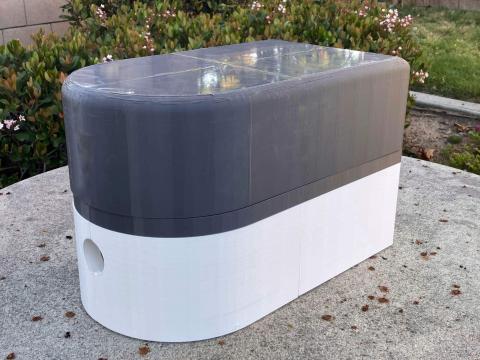
The United Nations estimates that 400 million tons of plastic are produced annually leading to 4.83 trillion microplastic (MP) particles floating in the ocean. When ingested by humans, MPs cause inflammation, endocrine disruption, and DNA damage. MicroMola is a semi-autonomous floating near-surface robot designed to reduce microplastic density and support ocean health monitoring efforts by agencies like the EPA and Orange County Water Board. The main objective of the robot is to reduce the microplastic density in a body of water with minimal maintenance. The key impact is filtration of MPs as MicroMola possesses the potential to help reduce the risk of MPs to human health and ocean ecosystems. During fall quarter, the initial design of the MicroMola was completed by determining a bill of materials, calculating the necessary power budget, and discussing the protocols for communication. In the following Winter Quarter, the objectives achieved were: completing a working...
The courses for the capstone projects in the Department of Electrical Engineering and Computer Science (EECS 159A/B) are run by Assistant Professor Maxim Shcherbakov (maxim.shcherbakov@uci.edu) and Associate Professor Hung Cao (hungcao@uci.edu). They run the capstone project sequence during the fall and winter quarters. Interested industry is encouraged to reach out to Prof. Hung Cao at hungcao@uci.edu.

Omni-Pedal: A Multi-Effects Pedal
“Omni-Pedal” is a digital multi-effect guitar pedal, that is accessible and affordable for guitarists or music enthusiasts of any skill level. The guitar pedal is built from the ground-up off of a Raspberry Pi to perform digital signal processing (DSP). Through DSP, seven guitar effects can be applied to the input signal from the guitar to change the sound of the guitar to the user's choice. The interactive GUI of the pedal also allows for accessible switching between the different guitar effects and also adjusting the volume, mix, and other parameters of the effect over the guitar's sound.
Passive Analog Beamforming Drone Monitor
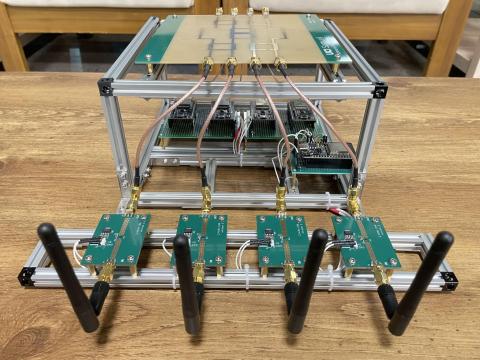
The FAA now requires all drones to be compliant with Remote ID, requiring an on-drone device that transmits information about itself over Blutetooth or WiFi. However, these signals can be weak and may not be picked up by user devices alone. Traditional methods of increasing reception range involve high cost and complex fully-coherent sampling digital beamformers. By leveraging a hybrid digital-analog beamforming strategy, this project achieves a similar result a remarkably lower cost, complexity, and footprint.
The goal of this project is to increase the reception range of 2.4GHz Bluetooth/WiFi signals by using an antenna array fed into a passive RF network allowing multiple different directional beams to be monitored at the same time using low cost microcontrollers. The collected data is sent over Bluetooth to a user device where the information is displayed on a custom React Native app.
Photon Flight: Fiber-Optic Autonomous UAV
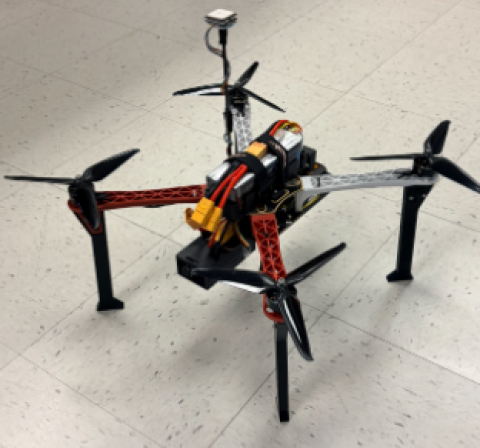
The Photon Flight (Autonomous UAV) project focuses on creating a high-performance tethered drone capable of sending two real-time video streams and complete flight telemetry through a single fiber optic cable. Using a lightweight fiber tether instead of conventional RF connections, the platform demonstrates how advanced networking, optical communications, and embedded systems can be merged within an aerial vehicle. Throughout the process, the team gains experience with IP video streaming, low-latency video encoding, network design, Embedded Linux integration, and connecting entire system with a flight controller (MATEK F405). The main objectives are to build a reliable, high-bandwidth communication system, show consistent fiber-based command and control, and assess the advantages of optical tethering for secure, interference-resistant drone operations. In the end, this drone acts as a test platform for new communication technologies in robotics, monitoring, and environments where electromagnetic interference is an issue.
The main goal of this project...

PoseMotive
PoseMotive is a wearable posture-monitoring system designed to help users improve their posture and body language through continuous feedback and data analysis. The system consists of 5 inertial measurement unit (IMU) sensors embedded in a wearable garment that measure body orientation and motion. A microcontroller gathering all the data from these sensors and aggregating the information and forwards it to a web application via bluetooth. The application communicates to a backend system through wireless communication which processes the sensor data and classifies the user's posture into interpretable categories such as slouched, straight, leaning left, leaning right, and arm positioning such as open or closed. The overall goal of the project is to promote better ergonomic habits by helping users become aware of posture issues and correct them through consistent monitoring and feedback.

Preventing Vial Waste Using a Multi-Modal Edge Computing System
This project addresses the need for fast and reliable defect detection in pharmaceutical manufacturing, where traditional inspection methods often rely on human oversight or cloud based processing that introduces latency and inconsistency. Defects such as micro cracks, improper sealing, or temperature anomalies in vials can compromise drug safety, leading to costly recalls and potential risks to patient health. By leveraging edge computing, the system performs real time, on device analysis that reduces latency while also lowering data transmission requirements and overall carbon footprint compared to cloud dependent approaches. This work directly impacts pharmaceutical manufacturers, quality assurance engineers, and ultimately patients who depend on safe and properly handled medications.

RepHlux: A Wireless, Batteryless Acid Reflux Monitor
The RepHlux project aims to develop an improved, minimally invasive medical device for diagnosing Gastroesophageal Reflux Disease (GERD), helping to prevent long-term health complications through more effective monitoring.
Current acid reflux monitoring methods rely on either battery-powered capsules or wired catheter systems. Battery-powered devices tend to be bulky and have limited operational lifetimes, while catheter-based systems can cause significant discomfort for patients. These limitations create a need for a more patient-friendly and reliable solution.
RepHlux addresses this gap via a belt-and-capsule transceiver system that uses radio frequency communication to transmit data between the capsule and an external belt reader. By eliminating the need for batteries and wires, the device enables real-time monitoring while improving patient comfort.
This project features an improvement in signal retention and upgraded specifications from previous works on a battery-less acid reflux monitor paper.

REX0: Dual Glove Stroke Therapy System
Stroke survivors frequently experience upper-limb impairment, with 55–75% losing fine motor control, and recovery often plateaus within six months, highlighting the need for accessible, high-repetition rehabilitation tools. Because proprioception—the body’s sense of limb position and movement—is commonly impaired after stroke, improving it is critical for restoring hand function. This project addresses that need by developing REX0, a dual-glove wearable rehabilitation system that enables motion mimicry, allowing movements from a patient’s healthy hand to be replicated on the impaired hand for proprioceptive training. The system aims to improve long-term rehabilitation outcomes for stroke survivors who require effective and engaging therapy for hand motor recovery.

Scrappy
Additive manufacturing has greatly improved rapid prototyping and small-scale production, but post-processing steps such as support removal, surface finishing, and print-bed cleaning remain largely manual and labor-intensive. These tasks introduce inefficiencies, inconsistencies in product quality, and potential safety risks due to exposure to chemicals like acetone used in vapor smoothing. Scrappy addresses this problem by developing a robotic system capable of automating these post-processing operations. By reducing manual labor and human exposure to hazardous materials, the project aims to improve safety, repeatability, and overall efficiency within additive manufacturing workflows.
SmartCan
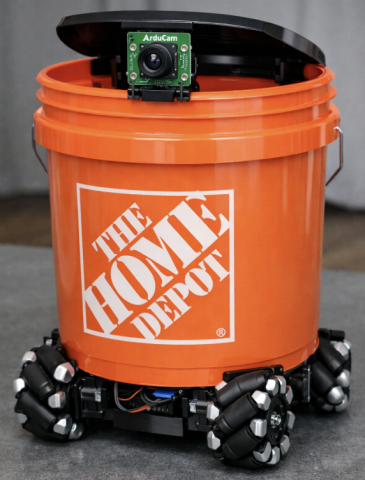
SmartCan is a smart sorting bin designed to identify and collect recyclable materials using computer vision. Improper waste disposal and low recycling rates contribute to environmental issues, while individuals with mobility limitations may face challenges in properly disposing of waste. This project addresses both concerns by creating an autonomous system that can detect recyclable objects and move toward them. By combining accessibility with sustainability, SmartCan aims to promote cleaner environments and make recycling more convenient for a wider range of users.
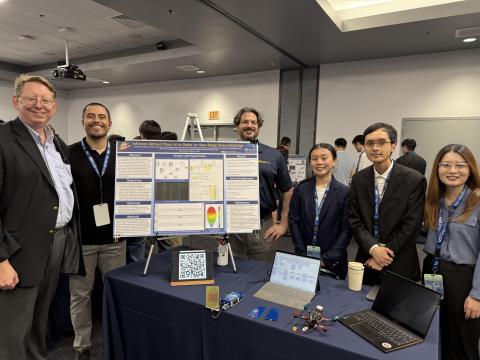
Software-Defined Phase Array Radar for Near-Range Drone Detection
The signal strength necessary to identify small radar cross sections of miniature drones has resulted in most modern radars designed for this task being highly expensive and energy-intensive, rendering them impractical for use in an instructional setting and pushing university curricula to lean toward simulation as opposed to real-world testing. We are designing a cost-effective, energy-efficient phased array radar module using the ADALM-PLUTO software-defined radio (SDR), capable of detecting unmanned aerial vehicles (UAVs) at short to medium ranges. The proposed model may act as a replicable instructional platform for radar experimentation and a foundation for small-scale research in UAV detection and target classification.
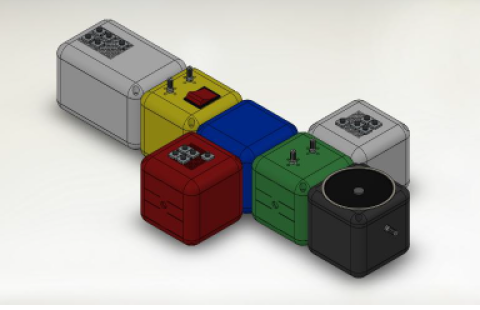
Synthesizer Blocks
The project addresses the challenge of making analog signal processing and synthesizer operation accessible to beginners, since conventional synthesizers are often costly, highly complex, and difficult to interpret without prior technical knowledge. To address this, a modular educational system called Synthesizer Blocks was developed, in which individual signal-processing functions such as waveform generation, filtering, mixing, and amplitude modulation are implemented as physically interchangeable blocks. This architecture enables users to assemble signal chains while directly observing waveform changes through built-in test points, supporting a clearer understanding of electrical engineering fundamentals. The scope of the project included the design, fabrication, and validation of PCB-based functional modules capable of producing audible output while serving as a hands-on instructional platform for signal processing concepts.
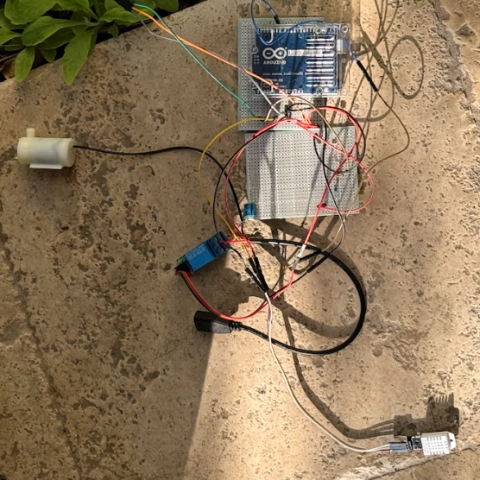
TeraFlow: An AI-based Autonomous Irrigation System
Water scarcity and inefficient irrigation practices continue to pose challenges for agriculture and small-scale plant management, as traditional watering methods often rely on fixed schedules that fail to adapt to real environmental conditions. This project addresses the need for a smarter irrigation solution by developing TeraFlow, an autonomous irrigation system that integrates environmental sensors, IoT communication, and AI-based image analysis to make informed watering decisions. By collecting real-time data on soil moisture, temperature, humidity, and light conditions, the system helps users monitor plant environments and automatically control irrigation when necessary. The project matters because it promotes more efficient water usage and provides accessible tools for gardeners, small-scale growers, and plant caretakers who need reliable and data-driven irrigation management.
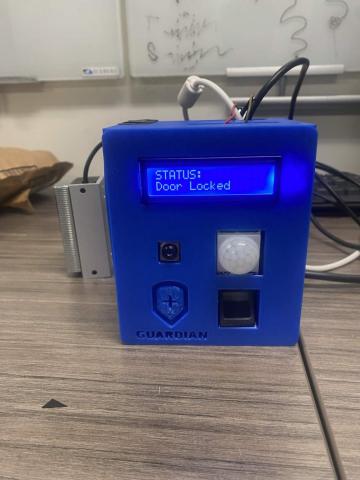
The Guardian - Home Security System
Home security remains a important concern for residents in the United States, with millions of residential burglaries reported each year, yet many existing security systems are expensive, complicated, or difficult to customize. Because of this, many households do not have access to reliable protection for their homes. The Guardian Home Security System addresses this problem by creating an affordable system that combines motion detection, camera monitoring, door locking, and fingerprint authentication into one easy-to-use platform. The Guardian shows how modern technology can make home security more accessible to everyday homeowners and renters who want a simple and effective way to monitor and protect their property.
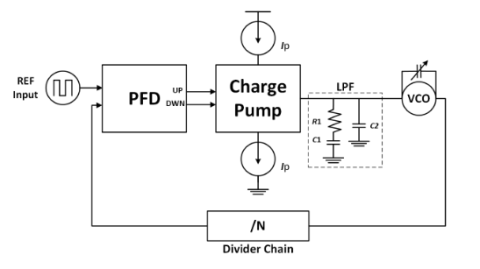
The Impact of VCO Coupling with Control Voltage on Spurs
Phase locked loops are a critical component in modern communication, sensing, and imaging systems. While computer automated design tools allow for accurate simulation, they often take weeks of design and computing time. Our project's research intends to model a specific non-ideal performance of analog phase locked loops, previously not studied, as closed form equations. This allows designers to observe their system's performance in seconds, rather than weeks.

Zpotless
Litter and debris accumulation in outdoor pedestrian areas poses significant environmental, aesthetic, and economic challenges, driving up municipal maintenance costs while degrading public spaces used by communities daily. Zpotless addresses this problem by designing a fully autonomous, solar-powered cleaning robot capable of detecting, retrieving, and storing trash in outdoor public spaces with minimal human intervention. The system is built to be entirely self-sustaining by leveraging photovoltaic (solar) energy, eliminating dependence on external power infrastructure and enabling extended operation. This project matters because it targets a recurring, labor-intensive problem that affects residents, pedestrians, and facility managers in both residential and urban commercial environments.