EECS
2025-2026
Spring
Internally Mentored (faculty, staff, TA)

RepHlux: A Wireless, Batteryless Acid Reflux Monitor

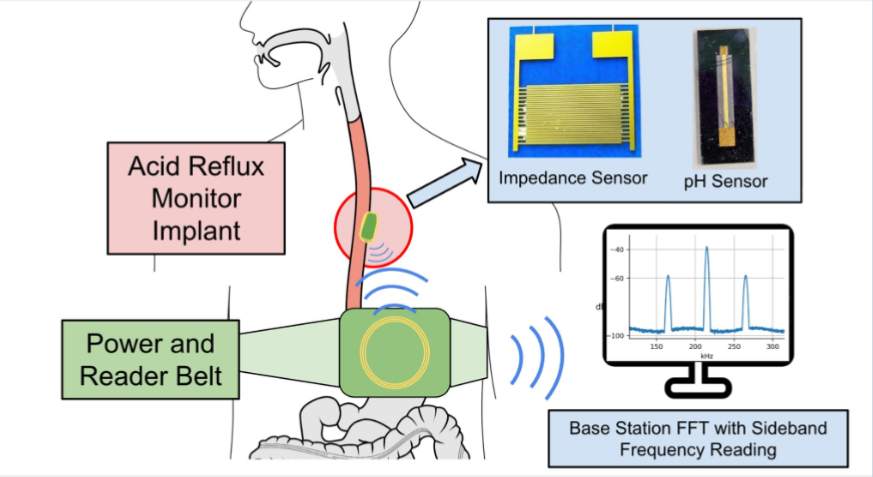
RepHlux Body Diagram

Summary

The RepHlux project aims to develop an improved, minimally invasive medical device for diagnosing Gastroesophageal Reflux Disease (GERD), helping to prevent long-term health complications through more effective monitoring.

Current acid reflux monitoring methods rely on either battery-powered capsules or wired catheter systems. Battery-powered devices tend to be bulky and have limited operational lifetimes, while catheter-based systems can cause significant discomfort for patients. These limitations create a need for a more patient-friendly and reliable solution.

RepHlux addresses this gap via a belt-and-capsule transceiver system that uses radio frequency communication to transmit data between the capsule and an external belt reader. By eliminating the need for batteries and wires, the device enables real-time monitoring while improving patient comfort.

This project features an improvement in signal retention and upgraded specifications from previous works on a battery-less acid reflux monitor paper.

Technical Approach/Methodology

We address this problem by using sensors inside a small capsule to measure acidity (pH) and detect reflux events through changes in electrical signals. The system is divided into two main components: an internal capsule and an external belt.

The belt wirelessly transmits radio frequency (RF) energy to the capsule, which is then converted into usable power to operate the sensors. As the pH levels change, the capsule modifies the RF signal, effectively encoding the sensor data into the wireless signal.

On the external side, the belt contains a microcontroller that captures these signal changes, processes the data, and sends it to a computer using a high-speed communication protocol (SPI). The data is then visualized and plotted using Python, allowing for clear and easy interpretation of the results.

Outcomes

By the end of the project, we produced a working bench-level prototype of a batteryless, wireless acid reflux monitoring system and successfully validated the fundamental systems of the device.

We were able to successfully perform wireless power delivery through inductive coupling at 215 kHz, sustaining sufficient voltage to operate the implant at distances up to 15 mm. We also demonstrated load modulation telemetry, where sensor data is transmitted wirelessly using frequency-based encoding and detected on the belt receiver using frequency analysis (FFT).

The pH sensing subsystem was fabricated and characterized, showing a reliable response across relevant acidity levels, making it suitable for integration with the frequency encoding system. Additionally, we designed and simulated all major circuits, such as the voltage-controlled oscillators, filtering stages, and inductive links using LTspice to validate system performance.

On the hardware side, we developed a custom implant coil, verified signal decoding through frequency analysis, and validated microcontroller functionality for signal transceiver capabilities. A complete bill of materials (BOM) was finalized, and most components were procured and tested.

While a fully integrated PCB, capsule form factor, and in-vivo testing were not completed, the project has demonstrated feasibility for continued development and polishing. 

Project Media

Project Poster