
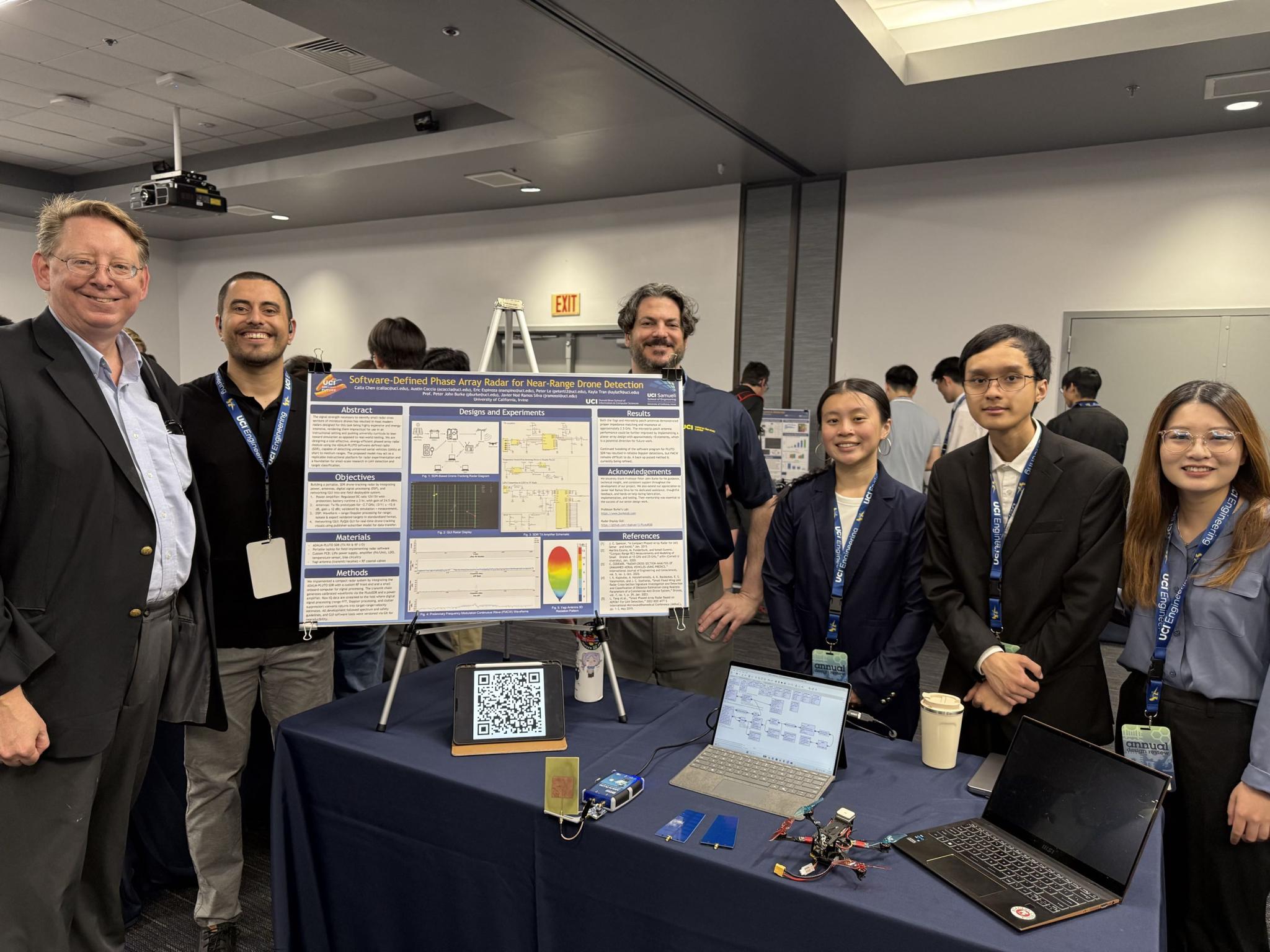
The signal strength necessary to identify small radar cross sections of miniature drones has resulted in most modern radars designed for this task being highly expensive and energy-intensive, rendering them impractical for use in an instructional setting and pushing university curricula to lean toward simulation as opposed to real-world testing. We are designing a cost-effective, energy-efficient phased array radar module using the ADALM-PLUTO software-defined radio (SDR), capable of detecting unmanned aerial vehicles (UAVs) at short to medium ranges. The proposed model may act as a replicable instructional platform for radar experimentation and a foundation for small-scale research in UAV detection and target classification.
EECS
2025-2026
Fall
Winter
Internally Mentored (faculty, staff, TA)
Software-Defined Phase Array Radar for Near-Range Drone Detection
Summary
Technical Approach/Methodology
Phased array radars detect drones by transmitting radio frequency (RF) pulse waves and receiving reflected energy bouncing back from the target. Detection certainty is dependent on the power received as given by the radar range equation, The visible target area shrinks as the drone moves further away, leading to increased transmission power and antenna gain as compensation. The signal strength necessary to identify small radar cross-sections of miniature drones has resulted in the majority of modern radars designed for this task being highly expensive and energy-intensive. The complexity of such systems renders them impractical for use in an instructional setting where resource constraints may be of concern, pushing university curricula to lean toward simulation as opposed to real-world testing. Software-defined radios (SDRs) serve as comparatively inexpensive alternatives by supporting radar functionalities via software rather than dedicated hardware. SDRs eliminate the need for traditional hardware components in many layers within the radar detection pipeline (e.g. waveform generation, up-down frequency conversion, amplification) and facilitate internal parameter reconfigurability, making them suitable for experimental field-testing in an academic context.
Outcomes
The project has reached several key technical milestones across the antenna, RF front end, and waveform-generation subsystems. The antenna array has been fully modeled in CST, and current simulations show stable resonance behavior and acceptable return-loss performance. The team has refined patch dimensions and substrate parameters in fabricating the first physical prototype. Both the Yagi and microstrip patch antennas demonstrated proper impedance of matching and resonance at approximately 2.5 GHz. The microstrip patch antenna performance could be further improved by implementing a planar array design with approximately 10 elements, which is a potential direction for future work. This is complemented by the first version of the transmit (TX) amplifier. This amplification stage is designed to bridge the link budget gap. Specifically, it is designed to accept a +5dBm output from the ADALM-PLUTO SDR and provide an output power of +30dBm. This gain stage will ensure the system achieves the required detection range for small UAV targets. The system has successfully produced a stable continuous waveform of approximately 2.51 GHz using the SDR, validating the baseband-to-RF path and serving as the foundation for upcoming chirped and pulsed radar modes
The software control infrastructure has advanced with a working GUI. The GUI is operational and now in a standby phase, awaiting the integration of the DSP algorithms from the radio backend to display real-time data. This modular readiness allows for immediate testing once the final DSP logic is linked. The system is positioned for full radar-pipeline integration once the DSP algorithms are finalized. Continued tweaking of the software program for PLUTO SDR has resulted in reliable Doppler detections, but FMCW remains difficult to do. A back-up pulsed method is currently being refined.
Project Media
Project Poster