
Water scarcity and inefficient irrigation practices continue to pose challenges for agriculture and small-scale plant management, as traditional watering methods often rely on fixed schedules that fail to adapt to real environmental conditions. This project addresses the need for a smarter irrigation solution by developing TeraFlow, an autonomous irrigation system that integrates environmental sensors, IoT communication, and AI-based image analysis to make informed watering decisions. By collecting real-time data on soil moisture, temperature, humidity, and light conditions, the system helps users monitor plant environments and automatically control irrigation when necessary. The project matters because it promotes more efficient water usage and provides accessible tools for gardeners, small-scale growers, and plant caretakers who need reliable and data-driven irrigation management.
TeraFlow: An AI-based Autonomous Irrigation System
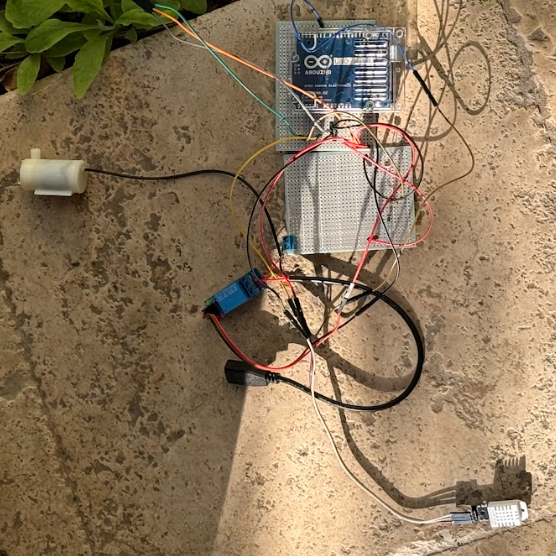
Summary
Technical Approach/Methodology
To address inefficient irrigation, the project builds a smart system that monitors plant conditions and automatically controls watering when needed. Environmental sensors connected to an Arduino microcontroller measure soil moisture, temperature, humidity, and light levels, and this information is sent over Wi-Fi to a remote server. The server, built with Python and Flask, stores the data in a database and displays it on a web dashboard where users can view trends and control irrigation. In addition, a lightweight convolutional neural network (CNN) analyzes uploaded soil images to recommend whether watering is necessary, providing an extra layer of decision support.
Outcomes
The project results in a working autonomous irrigation system capable of collecting environmental data, transmitting it to a remote server, and controlling a water pump based on real-time conditions. Users can monitor temperature, humidity, soil moisture, and light levels through an online dashboard that also displays historical trends and irrigation status. The system additionally integrates an AI-based image classifier that analyzes soil images and recommends whether watering is necessary. Together, these features demonstrate a practical approach to improving irrigation efficiency and supporting data-driven plant care.