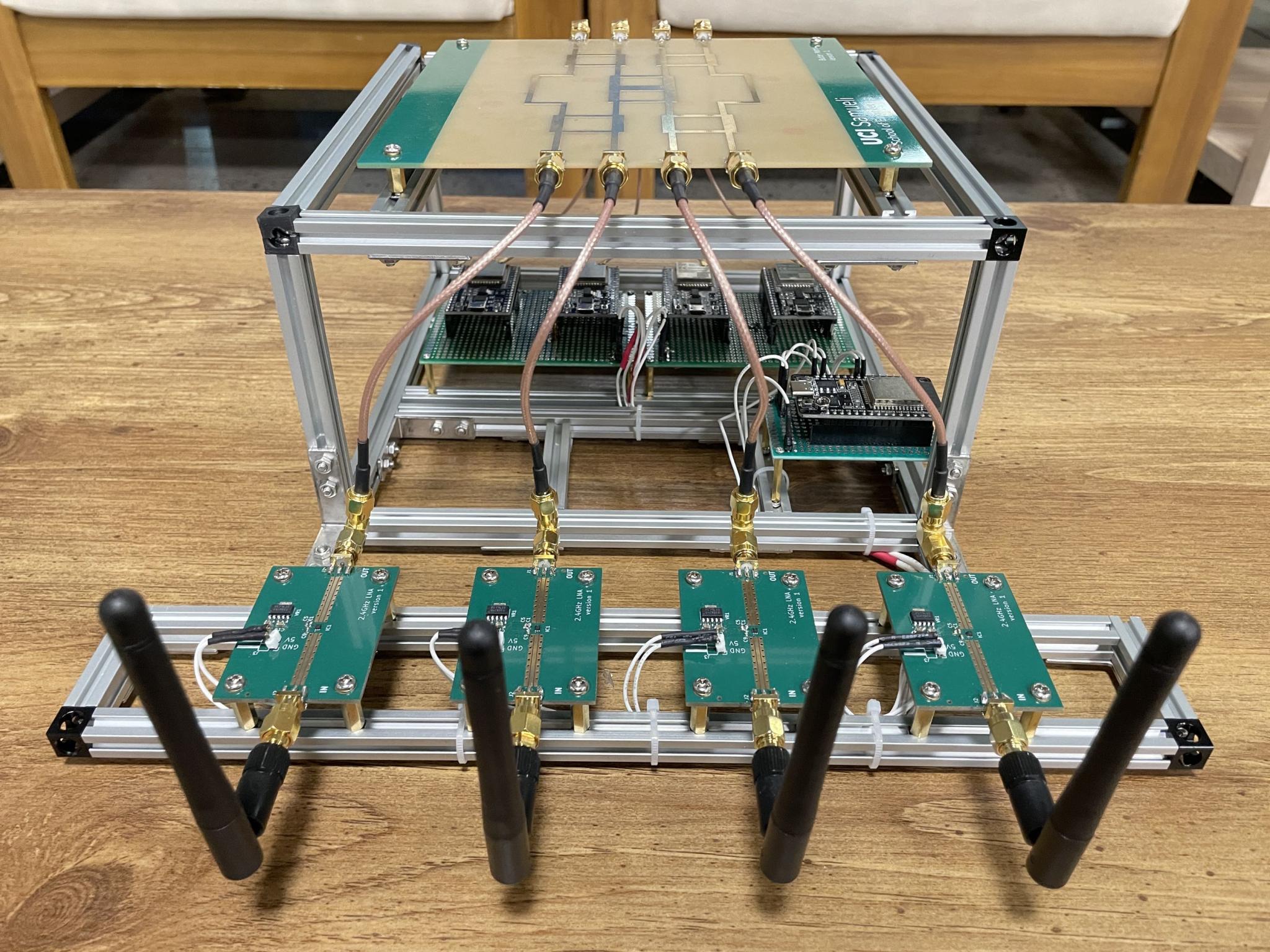
Image showing four antennas connected to a butler matrix, and the butler matrix connected to 4 ESP32s.
Summary: 

The FAA now requires all drones to be compliant with Remote ID, requiring an on-drone device that transmits information about itself over Blutetooth or WiFi. However, these signals can be weak and may not be picked up by user devices alone. Traditional methods of increasing reception range involve high cost and complex fully-coherent sampling digital beamformers. By leveraging a hybrid digital-analog beamforming strategy, this project achieves a similar result a remarkably lower cost, complexity, and footprint.

The goal of this project is to increase the reception range of 2.4GHz Bluetooth/WiFi signals by using an antenna array fed into a passive RF network allowing multiple different directional beams to be monitored at the same time using low cost microcontrollers. The collected data is sent over Bluetooth to a user device where the information is displayed on a custom React Native app.

Technical Approach/Methodology: 

A linear antenna array is used, made of four 2.4GHz dipole antennas, spaced half a wavelength apart. These antennas are fed into a passive RF network, called a butler matrix, where the beamforming occurs. For different phase slopes are created, each one corresponding to a different direction. Depending on which output port is used, a different phase slope is seen. Because of superposition, all 4 output ports can be monitored at the same time, and so all four directions can be monitored in true parallel by using a low cost integrated receiver (ESP32) at each output. The ESP32s are connected over I2C to a fifth ESP32 that collects and aggregates the data from the devices. The data is then sent over Bluetooth low energy to a user end device where all information can be displayed on a custom React Native app.

Outcomes: 

The system achieved 1.47x the range of a single dipole antenna, with a theoretical max range improvement of 2x. The relative intensity of the lobes were measured at different angles and confirmed the angle of the beams were within expected values. The react native app was tested on IOS.

EECS
2025-2026
Fall
Winter
Project Category: 
Internal (faculty, staff, TA)
Sponsor/Mentor Name: 
Professor Peter Burke
Project Poster: