
Stroke survivors frequently experience upper-limb impairment, with 55–75% losing fine motor control, and recovery often plateaus within six months, highlighting the need for accessible, high-repetition rehabilitation tools. Because proprioception—the body’s sense of limb position and movement—is commonly impaired after stroke, improving it is critical for restoring hand function. This project addresses that need by developing REX0, a dual-glove wearable rehabilitation system that enables motion mimicry, allowing movements from a patient’s healthy hand to be replicated on the impaired hand for proprioceptive training. The system aims to improve long-term rehabilitation outcomes for stroke survivors who require effective and engaging therapy for hand motor recovery.
REX0: Dual Glove Stroke Therapy System
Summary
Technical Approach/Methodology
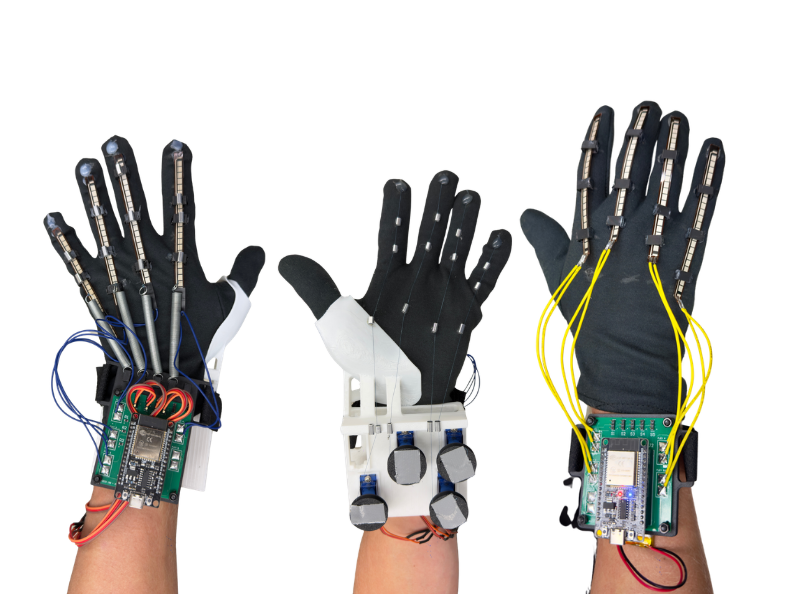
We are solving this problem by building a wearable rehabilitation system with two smart gloves and a simple app. The first glove uses flex sensors and ESP32 microcontrollers to measure how the user’s healthy hand moves, then sends that motion data wirelessly to the second glove using a fast low-latency connection. The second glove uses small servos, 3D-printed parts, wire, and springs to physically mirror those finger movements on the impaired hand, helping support proprioceptive training. A laptop or web app displays finger positions, records therapy data, and lets users and caregivers track progress in an easy-to-understand way.
Outcomes
By the end of the project, we produced REX0, a functional dual-glove rehabilitation prototype that captures finger motion from a healthy hand and replicates it on an impaired hand in near real time. The system includes a Control Glove with flex sensors for motion capture, a Response Glove with servo-driven wire actuation for motion replication, and a web application that visualizes finger positions and system activity. Experimental testing demonstrated reliable motion tracking and reproduction across four fingers, confirming the system’s ability to support mirrored hand-movement training. In addition to the working prototype, the project delivered comprehensive documentation and a scalable system architecture to support future expansion, including thumb integration, improved sensing accuracy, and enhanced rehabilitation software features.