
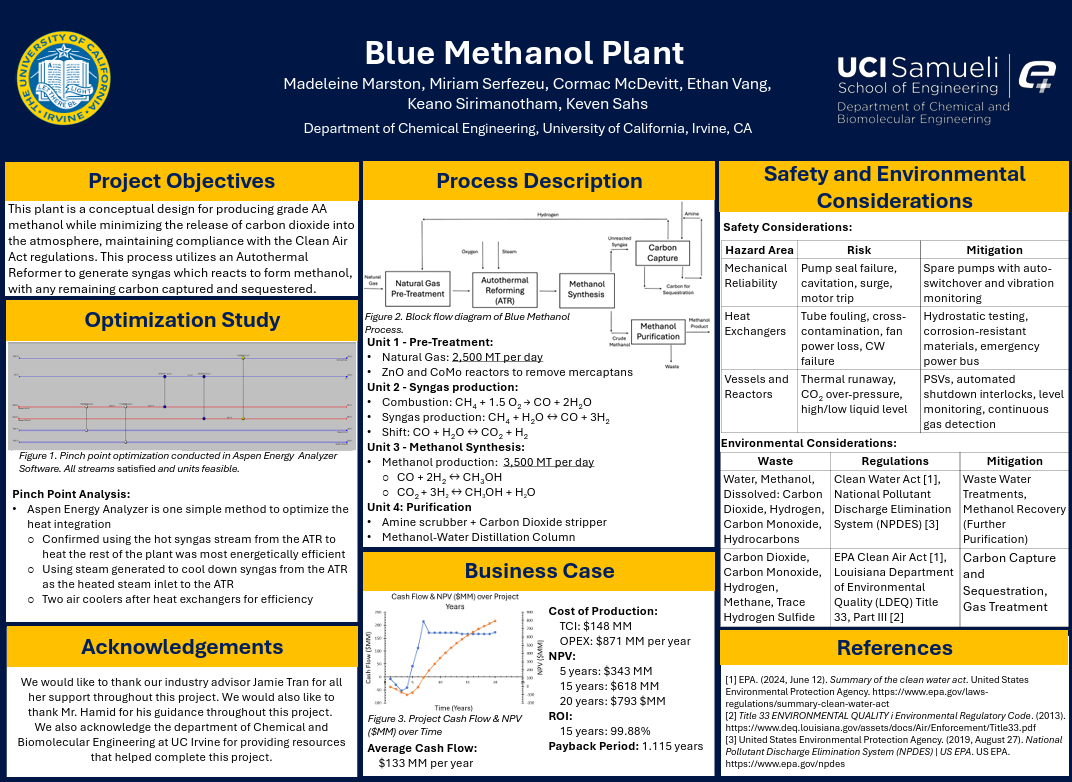
The courses for the capstone projects in the Department of Chemical and Biomolecular Engineering (CBE 150 A/B) are run by .... and are offered during the winter and spring quarters.
Sun, 10/04/2026 - 13:38
matsci
Materials Science and Engineering Club at UCI
The Materials Science and Engineering Club at UCI, commonly known as MatSci@UCI, is a social and professional organization to connect the field of materials science with students. We provide opportunities for the undergraduate community to create lasting connections with MSE graduate students and faculty. Club events include research mixers, lab tours, socials, company tours, industry speaker events, professor talks, cross-organization activities, panels, and more!
Fri, 09/25/2026 - 15:22
ornelaj4
Society of Hispanic Professional Engineers
SHPE at UCI has been active for over 10 years empowering the latine community here at UCI. As part of both the OAI umbrella of orgs, we aim to connect our members to resources and opportunities through OAI or our National Organization. All engineering disciplines are welcome !



UCI Spacecraft Thermal Management Systems

Research Mission: The goal of Spacecraft Thermal Management Systems (STMS) is to be developing several Variable Emissivity Device prototypes, or VEDs, one of which is to be applied as payload to a CubeSat and launched into Low-Earth Orbit. This VED will mitigate thermal loads from the sun and internal satellite electronics and offers a low-cost thermal control solution to absorb or reject heat from spacecraft. We work closely with the UCI CubeSat project to coordinate the VED and satellite operations.
Team Structure and Divisions: The research team is split into two division: the Mechanical + Aerospace Division and the Chemical + Materials Division.
The Chemical + Materials Division works to develop the electrochromic VED, which uses an oxidation-reduction reaction with Tungsten trioxide and Nickel oxide ions to induce coloration when voltage is applied. The subteams in this division are:
- Tungsten Subteam: manufactures the Tungsten thin film deposition procedures and slides
- Nickel ...
Spacecraft Thermal Management Systems

Spacecraft Thermal Management Systems (STMS) is an undergraduate, interdisciplinary research/design project that works to develop an electrochromic cell for space applications for Cube and Nano Satellites. This device will act as a method of controlling heat from going into and out of the satellite through a color change, which affects how much heat is being allowed into the system. Such spacecraft are not exposed to a constant heat flux from the sun as a result of low Earth orbit. This device is special since the amount of color change can be modified to let in the proper amount of heat necessary for the spacecraft to operate.
The device works through a redox reaction pairing of nickel oxide and tungsten trioxide based films. When electrons are removed from each film, the nickel oxide will color to a dark brown and the tungsten trioxide will bleach to a clear coloration. Similarly, when electrons are added to each film, the nickel oxide will bleach to a clear coloration and the tungsten trioxide will darken to a blue coloration. When these thin films are combined, both pairs will either darken or bleach at the same time, forming the device.