
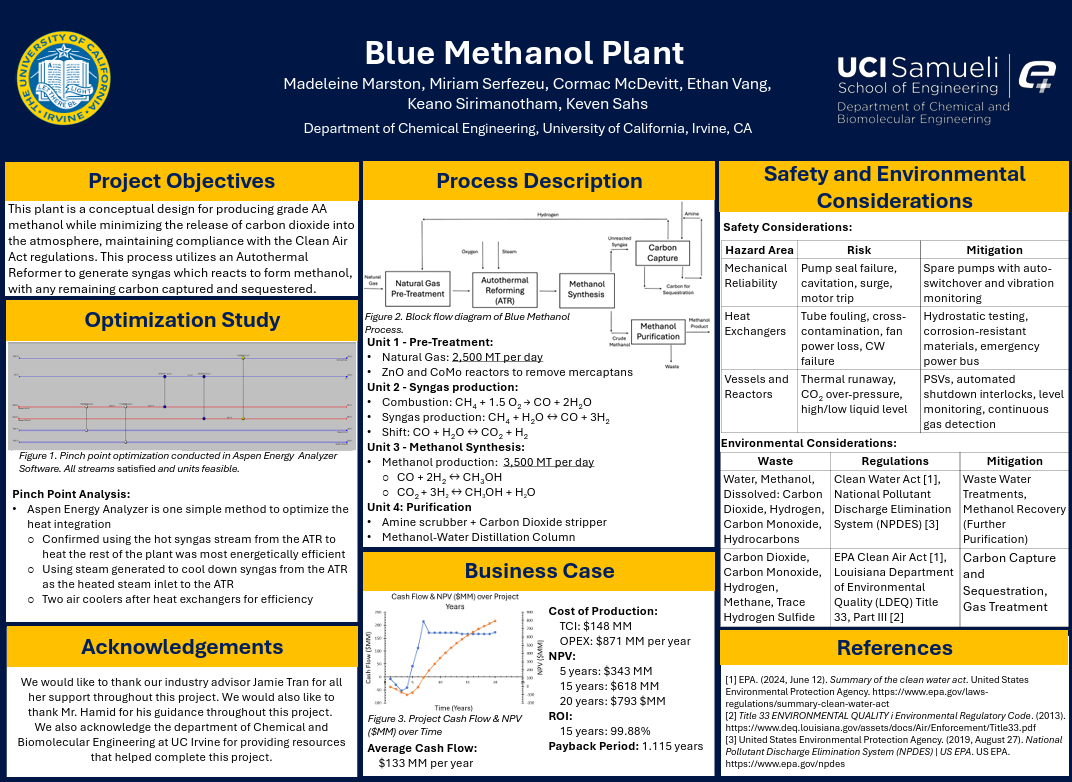
This report presents a technical and economic evaluation of a blue methanol plant designed to produce 3,500 metric tons per day of grade AA methanol with a product purity of 99.86%. The process consists of using natural gas feedstock, autothermal reforming, methanol synthesis, and carbon capture technologies to produce low-carbon methanol while achieving approximately 95% carbon dioxide emission capture. This complete technical package includes the development and design of the process, along with process simulation, equipment sizing, safety analysis, environmental considerations, and a techno-economic assessment.
CBE
2025-2026
Spring
Industry Sponsored
Blue Methanol
Summary
Technical Approach/Methodology
To evaluate the technical feasibility of the proposed design, a robust simulation of the proposed process was performed in AVEVA PRO/II. Simulation results demonstrate that the facility can achieve the desired production capacity and product purity while maintaining efficient operation. The facility is designed to operate 8,000 hours per year, and is located in Geismar, Louisiana due to its ease of access to natural gas, existing chemical infrastructure, and established carbon capture resources. The production capacity of 3,500 metric tons (MT) of blue methanol per day was derived from feed rates of 2,458 MT of natural gas per day, 3,837 MT of steam per day sent to the boiler, and 1,027 MT of high-purity oxygen per day for the autothermal reforming reactor. Heat integration and process optimization were implemented to improve energy efficiency and reduce operating costs.
Building upon technical design, a detailed economic analysis was conducted to evaluate the financial viability of the proposed project for investment purposes. The total capital investment for the proposed project was estimated at $155.2 million (MM). The cost of production was estimated considering operating costs, feedstock pricing, plant utilities, wages, capital charges and any overhead costs, and found to be $714.99 MM annually. Over a 20-year project life, the proposed facility achieved a net present value (NPV) of $714.6 MM, and an internal rate of return (IRR) of 53.6%, indicating strong economic stability under the assumptions used in this study.
By observing the projected NPV for this project, it can be seen that the proposed methanol plant is financially profitable after seven years. The calculated IRR values show that this project exceeds industry standards after 10 years. While the current economic predictions are positive, it must be noted that the blue methanol market is expected to grow significantly in the coming years, further increasing the economic predictions made in this report [1]. Thus, from the economic analysis of this project and its projected profitability, this project is recommended to be designed and implemented for the synthesis of blue methanol.
Outcomes
A techno-economic analysis of a blue methanol plant was provided in this preliminary report. The development of an AVEVA PRO/II simulation, plot layout, PFDs, MSDs, P&ID, an HMB, and simulated Line List were used to complete the preliminary design and visual representation of the plant. These resources were developed considering physical process constraints and realistic conditions. Detailed descriptions of the four process units provide the necessary information needed to understand the functionality and design of the system as a whole. This improves the understanding of how the entire methanol production system works and enables the reader to visualize the design process.
All aspects of this project account for the process basis typically represented in industry which includes desired plant capacity, feed conditions, and product quality requirements. This was set by having a specific goal in mind and then implementing the necessary calculations into simulations. After creating the simulation, outside considerations, and necessary criteria for technical developments were incorporated into the first design, allowing for further and more effective design of the plant entirely. This then produced a blue methanol plant that could produce 3,500 MT of 99.86 vol% pure methanol Grade AA methanol daily.
An economic analysis was performed on this project in order to evaluate the cash flow over a 20-year period. This analysis resulted in an NPV of $793.0 MM after 20 years and a cost of production of $714.99 MM annually. These values indicate that this preliminary design plant has large profitability potential even if the cost of production or initial investments were to increase beyond the expected forecasting prices. Thus, from an economic perspective for this project, this design is recommended for the synthesis of blue methanol. Although there are some additional factors to consider, the plant has a large net positive cash flow, which allows for a more defined design with higher costs to still expect a positive annual cash flow. From the cash flow analysis, it was determined that the payback period would take only 1.124 years. This establishes how impressive the gross margin generated by this plant is. This makes this model extremely profitable and provides a more sustainable and safe plant for future use.
One recommendation to improve the carbon capture plan would be to expand the sequestration zone. Currently, the carbon sequestration forecast is at $94 per MT, but it doesn't specifically define the region. One convenient area to sequester the captured carbon is the Sparta series. The Sparta series in Louisiana consists of deep and excessively drained soils that feature sandy outwash. Under the United States Geological Survey (USGS), the Sparta series is defined as a geological carbon sequestration area that covers a large portion of land right below New Orleans, LA [50]. This area is available for sequestration and has about 1,800,000 megatons of accessible carbon dioxide storage capacity.
Project Media
Project Poster