
Traditional prosthetics are often prohibitively expensive, ranging from $5,000 to over $100,000, and frequently require invasive medical procedures to function. This leaves many individuals in need of amputee care unable to afford or comfortably access life-changing mobility aids. To address this critical accessibility issue, our project developed a low-cost, electromyography (EMG) controlled prosthetic hand that utilizes a non-invasive dry-electrode placed on the user's wrist. By eliminating the need for invasive procedures and drastically reducing manufacturing expenses, this project demonstrates the viability of highly accessible, neural-network-driven prosthetics for a broader demographic
EECS
2025-2026
Fall
Winter
Internally Mentored (faculty, staff, TA)
Electromyography (EMG) Controlled Prosthetic Hand
Summary
Technical Approach/Methodology
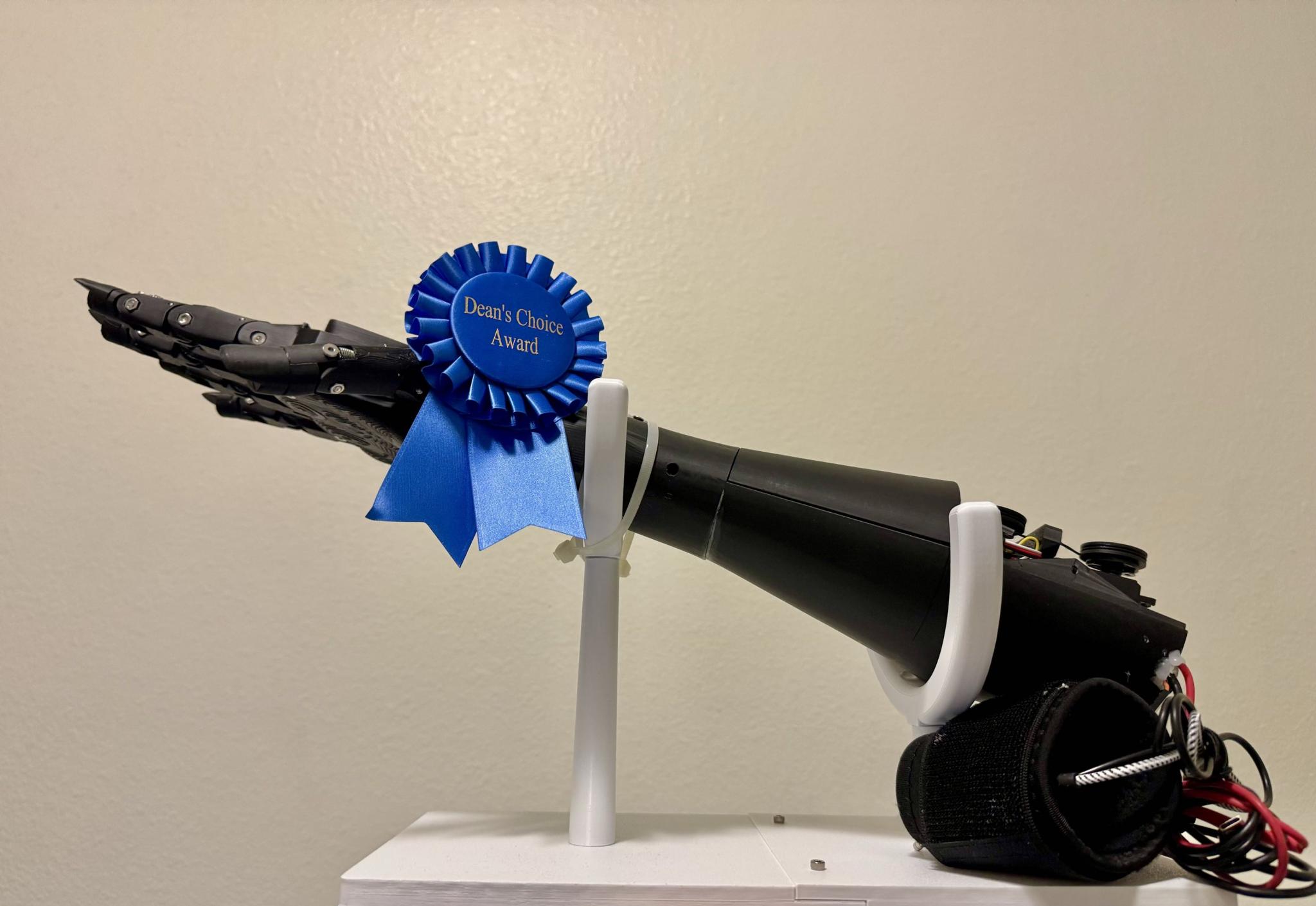
Our solution integrates a 100 MHz microcontroller, five continuous rotation servos, and an onboard analog-to-digital converter, all housed within a 3D-printed arm. A wrist-mounted electrode continuously gathers raw muscle signals, which an embedded Real-Time Operating System processes using a Fast Fourier Transform to create a spectrogram. This data is then fed into an embedded convolutional neural network (CNN), accurately translating the spectrogram into a motion classification. This classification is further processed by the devices internal state machine before being translated to mechanical motion. Additionally, the system concurrently streams live telemetry over USB to a custom desktop application, allowing for real-time data visualization and external user interaction.
Outcomes
We successfully manufactured the complete prosthetic device for under $260 utilizing accessible commercial 3D printers and off-the-shelf electronic components. The finished hand is capable of executing three predefined gestures—opened, closed, and active closing—with the embedded CNN achieving over 90% classification accuracy. The system easily met its real-time requirements with an average processing time of just 39 milliseconds per classification, and includes a functional desktop application that reads telemetry without packet loss. In recognition of the system's robust performance, low-cost accessibility, and overall engineering, our project was honored as one of the recipients of the Dean's Choice Award for the EECS department.
Project Media
Project Poster