
Wireless communication research requires testing and verification in constantly changing environments. However, existing wireless testing platforms are costly, difficult to operate, or offer limited user configurability. This project presents a practical, low-cost, vehicle-based wireless research platform designed to address these limitations. By using affordable off-the-shelf components, we have developed an adaptable wireless network testing interface that is user friendly and easily configurable, providing a reliable and flexible testbed for experimental research.
EECS
2025-2026
Fall
Winter
Internally Mentored (faculty, staff, TA)
Design and Fabrication of Programmable UGVs for Wireless Research
Summary
Technical Approach/Methodology
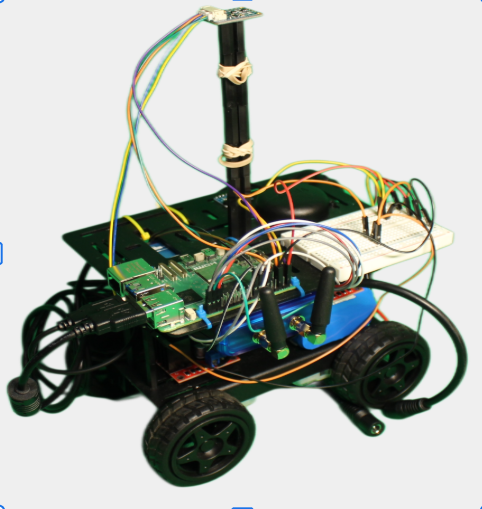
Our approach is to build a mobile research platform that integrates robotics and wireless communication. A Raspberry Pi processes GPS, magnetometer, and IMU data to enable autonomous navigation to user-defined waypoints. A Software-Defined Radio allows communication parameters such as frequency, channels, and protocols to be configured through software. A web-based interface provides real-time monitoring, navigation control, and communication configuration, while a second UGV is used to test wireless data exchange and relay between mobile nodes.
Outcomes
By the end of this project, a functional UGV-based wireless research platform was developed that demonstrates autonomous navigation and mobile wireless communication. The system allows the rover to navigate to user-defined waypoints using onboard sensors while transmitting data between platforms using Software-Defined Radio (SDR). A web-based interface was also created to visualize the rover’s position, configure radio parameters, and monitor transmitted data in real time. Additionally, two physical UGV prototypes were built to demonstrate communication and data relay between mobile nodes.
Project Media
Project Poster