
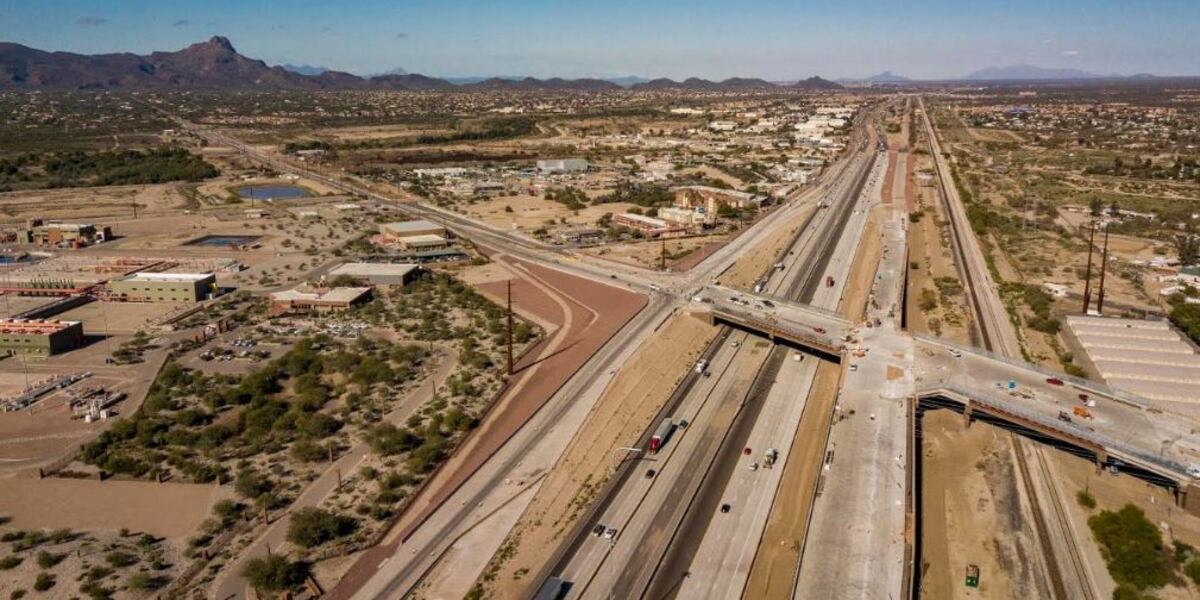
The bordering countries of the United States and Mexico are growing rapidly, both internally and externally, within their trade engagements. The current movement of goods, services, and people at the San Diego-Baja California border is becoming inadequate to suit these needs. A connecting road between California State Route 11 (SR 11) and Otay Mesa East Port of Entry (OME POE) is constructed to better suit expansion in the region. The project serves to improve movement across the border, particularly by reducing vehicle wait times. Additionally, gas emissions produced by the transportation of goods, services, and passengers will be reduced. As the area is expected to remain running for years, the project is also set to support economic growth by creating additional job opportunities near the border.
The portion assigned to Connect & Carry Co. is a smaller component of the overall project, the design of a 320 ft. two-span concrete bridge on Siempre Viva Road. Two 160 ft. spans are optimal for considerations of construction time, cost, and structural integrity. The bridge will primarily be built using pre-stressed cast-in-place reinforced concrete box girders. The superstructure includes a deck resting on box girders. The superstructure rests on the bridge seat, a shelf-like surface of the abutment directly supporting it. The bridge understructure includes columns, bent caps, abutments, wingwalls (which protect the sides of the abutments), foundations, and piles (where applicable). The bridge is post-tensioned with strands inserted into ducts to create cambering, which better resists gravity loads. Expansion joints, a gap left between each span, are used in the bridge to allow for self-equilibrium when experiencing expansion or contraction (a common occurrence due to phenomena such as material responses to temperature changes). The design should accommodate dead loads (self-weight), live loads (such as travelling vehicles), service loads (expected daily loads such as wind), and extreme events (seismic forces, within California). Leading up to the bridge, an approach slab smooths the transition from roadway to bridge and limits the settlement of roadway sediment directly next to the bridge, instead transferring vertical forces to a distance before the bridge and preventing damage to bridge joints. An alignment for the road and geotechnical reports for the soil are provided to Connect & Carry Co. for design purposes. The final bridge design includes two-way lanes and safety details such as a chain fence enclosure used to prevent objects from falling or being thrown onto the road and causing obstructions.