The capstone projects in the Department of Electrical Engineering and Computer Science is run by "faculty member name". Need to add more content specific to EECS.

AI Checkers Robot

 AI Checkers Robot

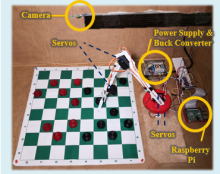
This project consists of constructing a robotic arm that plays checkers against a person. A computer vision algorithm will determine the position of the pieces based on input from a camera. These positions will be used by the AI player to decide the best move. The chosen move will then be executed by the the arm through a set of orders that will be provided to the servo motors connected to the arm. The code that controls the servos and runs the AI player calculations and the machine vision algorithm will be running on a raspberry pi.

FridgeBridge

Fridgebridge allows users to see and keep track of what goes in and out of their fridge through an app on their phone. Using Google Vision and Raspberry Pi for image recognition and load sensors to track scarcity, your fridge can send you your grocery list to make sure you don’t forget anything important and to alert you if your food has expired. It is also connected to the National Food Database to help you keep track of your calorie intake.

Magic Sleeve

Our project goal is create a device that allows those with vision impairment better navigate through life. We are using machine vision to read the data from the Raspberry Pi cameras and then we are mapping the data to a grid of vibration motors that correlates to the users location from an obstacle. 

JARC - Racecar Data Acquisition System & Emulator

Modern racecar telemetry systems are used professionally so the cost of these systems are not a concern such as it is to amateur racers. Entry level data loggers cost upwards of 600 dollars so we set a goal to create an affordable yet efficient data acquisition system for racecars as long as they have an OBD-II port.  Even though this has been attempted in the past, we have also set another goal to make the software we develop user friendly since past attempts were difficult to use.

PinPoint

Description:

PinPoint is a low-cost and low-power clap detection and locating system. Designed using two Analog Devices Blackfin DSP and two Raspberry Pi W in a mesh/client-server configuration allows for wide-area clap detection and location. The Blackfin DSP dedicates its full compute power towards analysing claps, while the Raspberry Pi Zero W handles connectivity and server interfacing.

Implementation

PinPoint is composed of several sub-systems known as a node. Each node contains the following:

  1. Analog Devices BF706 Digital Signal Processor (DSP) Development Board
  2. Raspberry Pi Zero W
  3. Raspbian Stretch Operating System running Apache
  4. 2 Edutige ETM-001 MIcrophones

The DSP deploys a matched filter algorithm that is characterized towards claps by defining a specific activation threshold

PinPoint's Team:

  1. Tommy Le
  2. Steven Long
  3. Kevin Wong
  4. Joseph Tran


Smart Power Strip

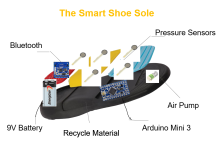
The Smart Power Strip (SPS) is motivated by current consumer interest in Internet of things Devices (IOT). Consumers desire the ability to automate their home environment. The SPS gives IOT funcality to non IOT devices. The SPS will allow a mobile client to control several outlets. The SPS will also send usage data collected to such a client.

BioTune

Wonder if machines can detect your likely mood based off non-invasive body sensor readings?  This project, BioTune, aims to incorporate feedback from biological sensors to not only determine your mood, but also more importantly play back an appropriate type of music to either motivate you or calm you.

Demo: https://www.youtube.com/watch?v=71acJs3_jto


Softwatch: A Smartwatch with Virtual Keyboard

Smartwatch is the biggest signal in this IoT age, but because some of its critical limitations such as input method, it kind gets hard time getting as popular as it is supposed to be. But there is always a way to solve the problem, think about what if the way you interect with your smartwatch is not limited in such a tiny screen anymore, it could be exended onto you own arm or wrist, we believe it will be a revolutionary change on Smartwatch, or even wearable devices, industry. With this being said, we are making a smartwatch that is able to project a virtual keyboard on our skin, users can just click buttons on their skin. We are planning on using laser diode to project graphs and time-of-flight sensors to detect fingers' clicking. 

Horus: Intelligent Home Package Security

Horus is an intelligent monitoring system for packages delivered to front porches. The project aims to solve the problem of package theft where a third of Americans reported their packages being stolen off of their front doors. 

Horus uses image recognition and machine learning to detect package arrivals, people and suspicious activities. Via machine learning, it learns from collected image data to improve detection capabilities for packages and thieves. The home owner can choose customized notification settings to know their package status at all times. 

Wireless Sleep Monitor


Project Goal:  Our project aims to build a more affordable wireless sleep monitor.  The device, strapped to the patient, will record EEG and ECG data. This data will be wirelessly streamed to a server where it will be recorded and could then be presented to a physician to be analyzed.

Team:  David Sargent  (CSE), Alexander “Sasha” Sidenko (CSE), Can Vu (EE), Steven Lam (EE)

The Sixth Sense

This project will use ultrasonic sensors to enhance a white cane, allowing it to inform the user of oncoming obstacles at a distance.The goal is to give the user more time to react when encountering upcoming obstacle.


Smart Speed Limit Sign

Neos aims to solve one of the world's most common hazards. Despite progressive technological advancements in car safety, these improvements alone are not sufficient enough in reducing the amount of car accidents happening on a daily basis. With the introduction of the Smart Speed Limit Sign (SSS), Neos hopes to not only create a safer driving experience where everyone will be more knowledgeable and aware of the conditions they are driving in but also to decrease the costly bills associated with accidents.

The Third Eye

The primary objective of the Third Eye is to improve the safety and functionality of a drone through the addition of face and eye detection control. We will be tracking the pilot’s eyes and face through the webcam of a laptop, which will show the live feed from the drone. By doing this, we hope that our drone and its supplemental software has the potential to reduce drone related incidents, making it safer and a more enjoyable experience.

iTrack

iTrack

The project will take input of the subject’s eye and shine a light from a flashlight at where they are looking. For example, disabled people in wheelchairs or people with impaired use of their hands can use the iTrack illumination system to intelligently illuminate an area they need without the use of their hands.

iTrack is a project built upon an elementary knowledge of machine vision. The members of Team Stack Underflow take prior knowledge of programming and expand it by learning what was needed from various open source libraries on the internet, such as openCV, to create, refine, and optimize the eye tracking code. Through a curiosity of machine vision, Stack Underflow has been able to expand this to create something exciting and innovative.

Analysis of Heliotropic Solar Panel Designs

Stationary solar panels are inefficient because throughout the day sunlight does not hit the solar panel perpendicularly due to fact the sun moves across the sky. Heliotropic models aim to address this problem by "tracking" the sun similar to heliotropism in plants.

Our project aims to analyze different design choices for the optimal heliotropic solar panel:

  • Adaptive vs Predictive Sun-Tracking - Adaptive sun tracking will face towards the direction with the most sunlight while predictive will face a predetermined position based on a sun-tracking algorithm given latitude, longitude, as well as time and day.
  • Single Axis vs Double Axis-Tracking - Observe the efficiency of rotating on a single axis vs that of two axes.
  • Photoresistors vs Photodiodes - Implementing adaptive sun-tracking using the two technologies to see which produces a more accurate reading.

Given the optimal design of the heliotropic panels, we hope create a cheaper and more...

Sign Language Translator

Sign Language is a universal language using gestures that is generally used by people who suffer from loss of hearing and speech to communicate with others. However, many people do not know sign language, making it difficult for those who are speech and hearing impaired to communicate with most people on a daily basis. The American Sign Language (ASL) Communications device aims to break the barrier between those who are unable to verbally communicate and those who can. We outfitted a glove with multiple sensors to capture motion and data from the hand guestures of the user. Then, our machine learning algorithm processes the data and outputs the translation into speech and text on a Smartphone or Laptop. By wearing a glove that can translate American Sign Language to text and speech using either a phone or a laptop, the speech and hearing impaired can communicate with anyone using sign language.

Advanced Garage Door System

The Advanced Garage Door System (AGDS) provides greater accessibility, and a higher level of safety that a standard garage door. Using various sensors and wireless communication protocols, the AGDS allows authorized users to monitor their garage door from anywhere. A webserver provides real-time feedback of the garage door status. This was created out of a real life necessity. One of the AGDS team members has a bad habit of forgetting to close the garage door. With the AGDS, a simple webpage displays the status of the garage door and also provides the ability to open or close the door remotely. There’s no need to drive home just to make sure the garage is closed.

Along with the accessibility improvements, the AGDS uses multiple high frequency sonar sensors and image recognition to monitor the area inside of the garage. The image recognition prevents damage or injury due to the closing garage door colliding with an...

Embedded Lock Recognizer

This project builds an embedded IoT lock system able to detect, identify, unlock for recognized owners. The embedded system provides additional security to any type of lock system (home doors, lockers, safes). It uses image processing tools and networking software. It uses a raspberry pi, camera, servo, and a server which are connected and integrated together. A client pi or any other embedded system can send images to the server-side to process the images. Face recognition software is implemented at the server to process the images and recognize an owner. Signals are sent back from the server to the client and ultimately unlock for a recognized owner or stay locked for an unrecognized owner. 

Mission Planner

MissonPlanner is an open source ground control station application on Windows designed for autonomous vehicles including drones and copters. Via cable or wireless connections like Bluetooth, it allows users to plan autonomous missions for their autopilot, analyze the mission logs, and simulate a flight.

Our project is to improve the post flight logs analyzing portion such as optimizing the user interface and implementing a selective export feature that can export synchronized data as an Excel sheet.

Medical Drone System

Our Project aims to build a medical drone system, which allows its users to acquire medical support delivered by an AI-Controlled drone under emergencies. Users can send request through mobile Network to our server, and the server will appoint a self-navigated drone to the user`s location, which is controlled by an Android device through stable connection between Drone controller and drone, so that it will enable multi task to be processed simultaneously.


Medical Drone, Save Your Life, Right Away.

RF Low Noise Amplifier for Neutrino Detection in Antarctica

Goal

The Goal of our project is to design a single stage Radio Frequency Amplifier for the ARIANNA Collaboration. The amplifier will be attached to the bachend of an antenna and lowered into a hole in Antartica, alloweing the signal strength and characteristic to be preserved as it travels through a coaxial cable to the data acquisition box. 

 Purpose

The Antartic Ross Ice-shelf  ANtenna Neutrino Array, known as ARIANNA, is a International collaboration with a goal of detecting High Energy Neutrino in Antarctica. High Energy Neutrinos bombard the earth everyday, and in fact, millions of them are passing through you right now. These Neutrinos have very interesting and important properties which allowed physicist to create a new kind of telescope and exploit a new kind of Astronomy.

First, neutrinos are chargeless like photons, which means they are not going to be bent up as they travel through the galaxy by magnetic fields [1]. Magnetic fields are everywhere,...

Pages