
Stairs remain one of the biggest obstacles for mobile robots, limiting their usefulness in real world environments. While robots excel on flat surfaces, they struggle with the vertical challenge of staircases. Our project addresses this problem by designing a robot capable of quickly and reliably climbing the Engineering Gateway stairs at UC Irvine while transporting a standard 0.5L water bottle. The core challenge is balancing torque, traction, weight, and stability to achieve a controlled ascent without flipping or stalling. This matters because first responders need robots that can access upper floors in collapsed buildings. Delivery companies need robots that can reach front doors beyond ground level. Individuals with mobility impairments could benefit from assistive devices that navigate stairs in their own homes. Our specific task of climbing the Engineering Gateway stairs with a water bottle serves as a testbed for these broader applications. The problem we are tackling affects anyone who needs robots to operate in human built environments, where stairs are everywhere.
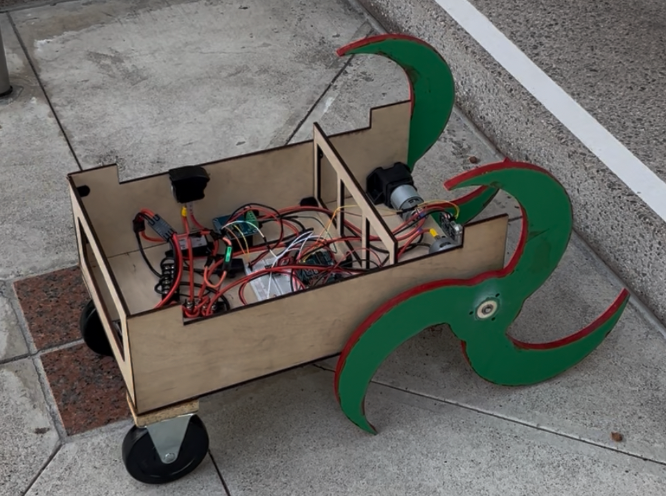
Stair Climber Robot Final Prototype
Summary
Technical Approach/Methodology
In order to design a drive train that could ascend a flight of stairs, we first had to consider the step geometry and design a wheel that could engage with the top of the step with enough friction to pull itself upward. Using CAD modeling early in the process, we iterated on the geometry to ensure the design matched the dimensions of the stairs at Engineering Gateway and would function as intended. We researched existing solutions and considered our budget, finally deciding on a curved-spoke triwheel as the key aspect of our drive train. This design was made specifically to the dimensions of the stairs and successfully engaged each ledge, pulling itself upward. By utilizing an outer rim to roll on the ground and curved spokes that could lay on the step above, our wheel fulfilled the task of mobility up the stairs. We powered our wheels with standard DC motors and controlled them using feedback from ultrasonic sensors to measure the distance to the next step, allowing the system to adjust wheel motion and timing so the spokes engage each step more reliably and maintain stable forward progression.
Outcomes
Our project resulted in the design and development of a stair-climbing robot prototype built to carry a standard 0.5 L water bottle up the Engineering Gateway stairs at UC Irvine. During the project, our team produced CAD models, developed and refined a curved-spoke triwheel drivetrain tailored to the stair geometry, and integrated the motors, structural components, and ultrasonic sensing system needed to support controlled stair ascent. These efforts led to the fabrication of a physical prototype and provided valuable testing data on drivetrain performance, stair engagement, balance, and overall system behavior. The project also produced a clearer understanding of the challenges involved in combining mobility, sensing, and stability into one working design. By the end of the project, our key deliverables include the prototype itself, final CAD files, design documentation, and test results that capture the progress and engineering decisions made throughout development. Together, these outcomes reflect both the work completed by the team and the potential of this design approach for stair-climbing robotic applications.