
Summary
Spanning several years, Aero Design @ UCI (formally UCI Cargo Plane) is a well-renowned project at the University of California, Irvine. This project provides a great opportunity for undergraduate students to learn the fundamentals of aircraft design, as it brings together the foundations of aerospace engineering and combines them with hands-on manufacturing experience. These skills will aid these members in future endeavors where they may design planes that could potentially carry more precious cargo. Given the formidable challenge by SAE, teams are expected to bring together unique perspectives in creating a one-of-a-kind RC aircraft, capable of meeting all constraints. All participating teams are expected to go through the entire design process, create a thorough design report, and present the team’s design to a panel of industry engineers.
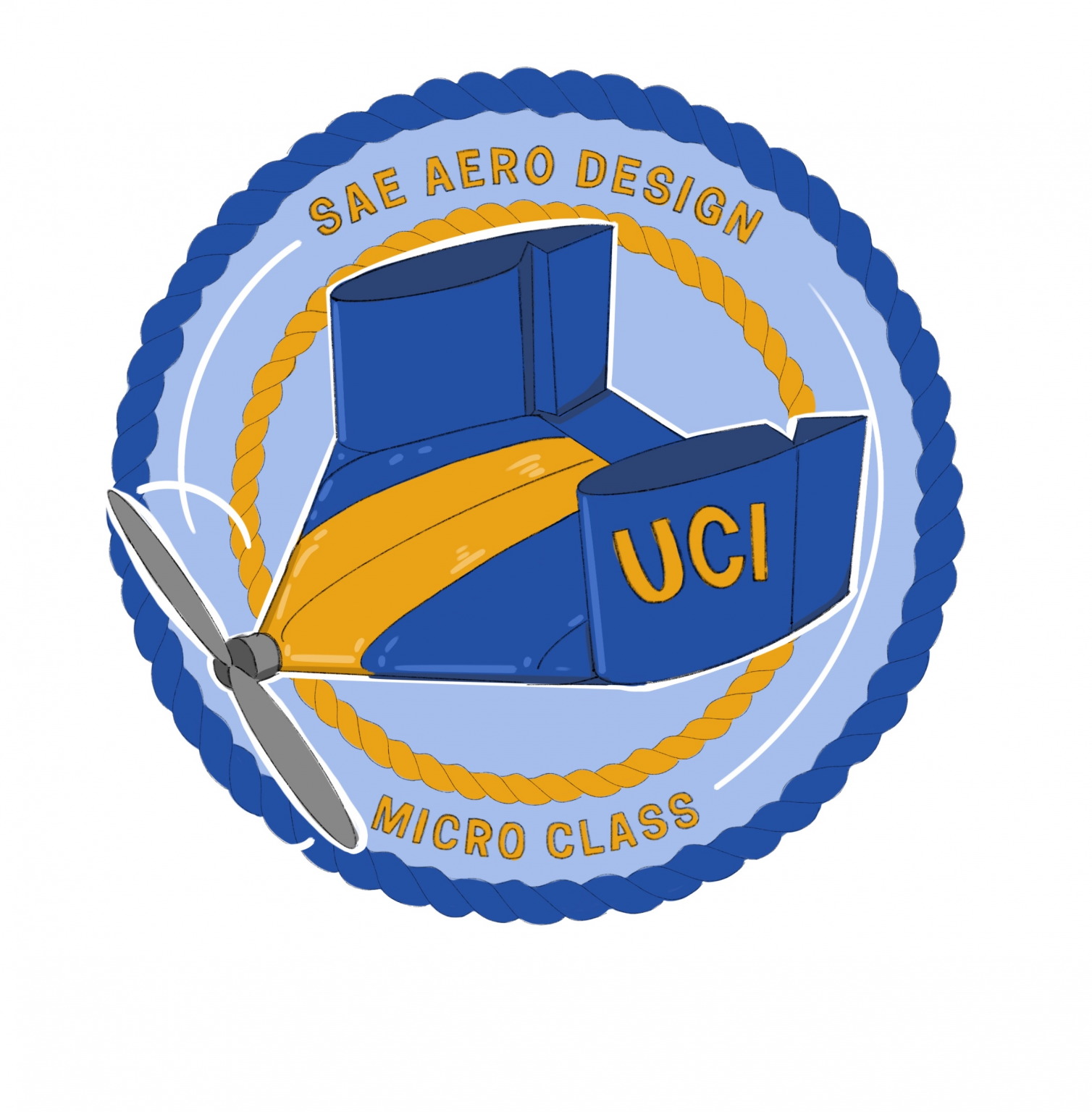
Our goal for our project is to design and build a small-scale aircraft that contains a liquid payload with minimal wingspan, whilst fulfilling all SAE Aero Design requirements. This aircraft is to compete at the SAE Aero Design West Competition (April 17-19, 2026) in Fort Worth, TX, under the Micro Class competition (other than the Regular Class which MAE 93 is fully participating).
- Complete Aircraft Optimization: Nov 17th, 2025
- Complete Preliminary Design: Nov 26th, 2025
- Create Iron Bird POC: Dec 5th, 2025
- Manufacture Airframe: Jan 30th, 2026
- Integrate Electronics: Feb 6th, 2026
- Test Flights: Feb 28th, 2026
- Design Report: Mar 1st, 2026
- Prep for Competition: Apr 6th, 2026
- Competition: Apr 17-19th, 2026
Technical Approach/Methodology
For a small-scale aircraft, a delta-wing configuration is selected based on payload and wingspan. We considered it the best setup, as it provides space for the payload while maintaining a relatively short wingspan compared to other aircraft designs. The control surfaces along the wing are elevons, which serve as elevators and ailerons on a conventional aircraft, offering both pitch and roll control. The design includes two vertical stabilizers for effective yaw control. Due to weight limitations and the restriction on using carbon fiber materials, most of the aircraft will be built from balsa and spruce wood and ABS filament.
Outcomes
The team was able to produce an aircraft that holds the required liquid payload with a three-foot wingspan. It achieved compliance from drop and thrust testing and validated it on the aircraft. Due to licensing constraints on the team, the team was not able to do a test flight with the plane itself. However, the team was able to achieve a low-speed taxi with effective steering and gyroscopic stability.
Team Contacts
- Darren Lam (darrenl7@uci.edu)
- Stuti Patel (stutinp@uci.edu)
- Bryce Mankovsky (bmankovs@uci.edu)
- Hudson Wheeler (hpwheele@uci.edu)
- John Mai (johntm1@uci.edu)
- Nishali Desai (desaink@uci.edu)
- Addison Rushing (addisomr@uci.edu)
Sponsor
- John Larue (jclarue@uci.edu)