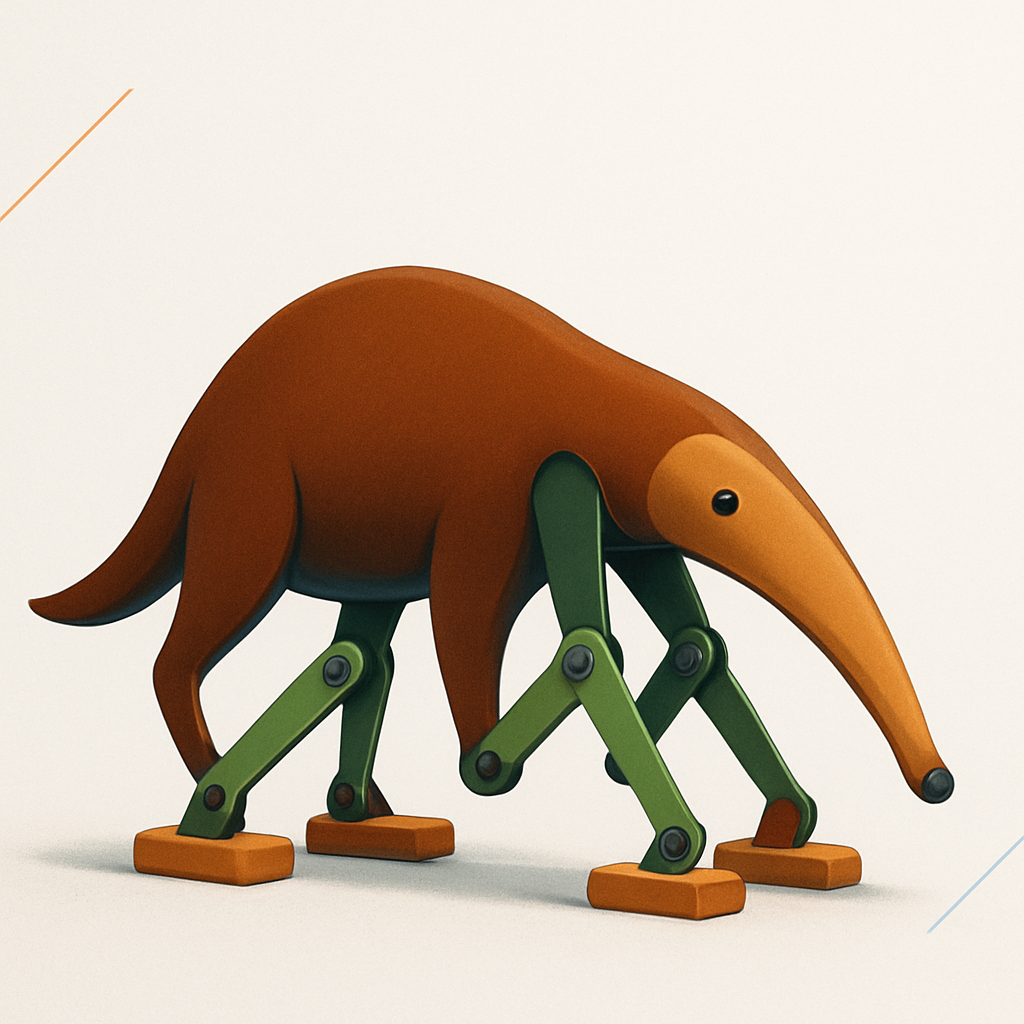
PeterBot four-legged autonomous walking robot.
Summary: 

PeterBot is an autonomous walking robot developed by MAE 151 Team 7 under the sponsorship of Professor J. Michael McCarthy. Building upon Professor McCarthy’s MAE 183 mechanical walker design, this project focuses on transforming the existing walking platform into an intelligent system capable of autonomous navigation. The project’s main challenge is reliably integrating the electronics to control stiff geared mechanisms.

This work is relevant to students, researchers and roboticists interested in implementing autonomous mobility on unconventional non-wheeled platforms. By developing PeterBot, Team 7 created a foundation for future students to create autonomous walking robots that can complete higher-leveled tasks.

Technical Approach/Methodology: 

PeterBot incorporates the following embedded computing, robotics software and sensors onto the mechanical walker to attain autonomous navigation:

  • NVIDIA’s Jetson Orin Nano microcomputer running Ubuntu 22.04 is the “brains” of PeterBot.
  • The LD14P LiDAR 360-degree sensor scans its surroundings and feeds obstacle distance data into the Jetson Nano.
  • With Robot Operating System (ROS2) providing the necessary applications such as Rviz2, SLAM toolbox and Nav2, PeterBot can build a 2D map of its environment, identify obstacles, and plan a path toward a selected destination.
  • An Arduino Uno R3 receives control signals from the Jetson Nano to spin the Pololu DC motors and returns their motor encoder data in a feedback loop.
  • PeterBot’s geared mechanism is attached to the DC motors based on the differential drive configuration.

This approach allows the robot to sense its environment, make navigation decisions, and move autonomously without manual Bluetooth control while simplifying the system and adapting it for future improvements.

Outcomes: 

Extensive work by Team 7 over fall and winter quarters culminated with a fully functional autonomous walking robot that was capable of mapping, obstacle avoidance and goal-based navigation. Key deliverables include the PeterBot prototype complete with integration of LiDAR sensor, navigation demonstrations and supporting project documentation. 

In addition, Team 7 designed a claw subsystem conceptualized for object retrieval tasks in the future. Overall, the project successfully demonstrated the feasibility of autonomous navigation on a walking robot and established a strong base for continued development.

Course Department: 
MAE
Academic Year: 
2025-2026
Term(s): 
Fall
Winter
Project Category: 
Internal (faculty, staff, TA)
Sponsor/Mentor Name: 
J. Michael McCarthy
Project Poster: 
Project Video: