
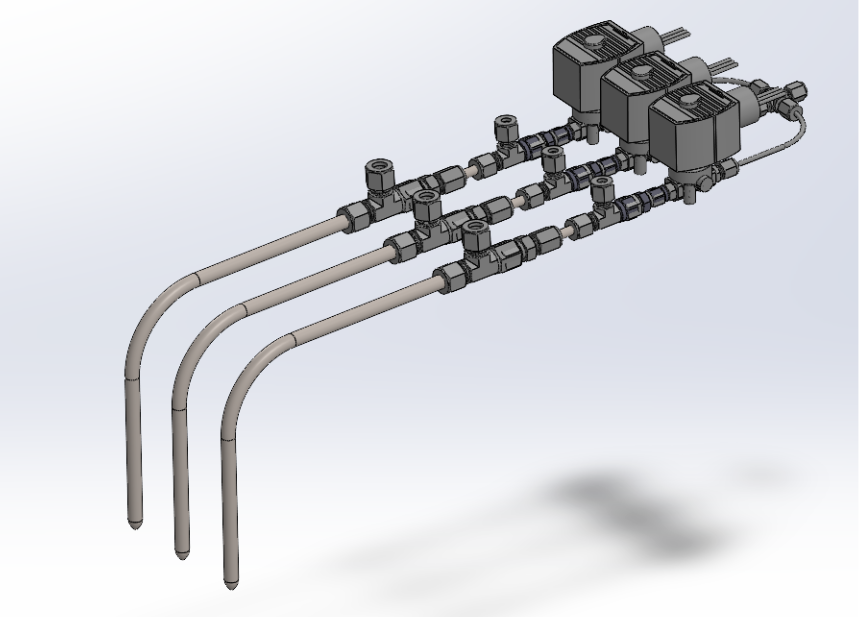
The Multi-Port Exhaust Emissions Sampling Probe was built to improve the accuracy and versatility of exhaust gas sampling in H₂–NG combustion testing. It has multiple independently controlled sampling ports so that emissions can be sampled at various positions within the exhaust stream without having to move the probe. The design uses modular fittings (Swagelok), which allow the system to be easily assembled or disassembled and to be scaled up to accommodate different experimental test rigs. Each port is attached to a solenoid valve system that is controlled by an Arduino and DAQ interface to automatically switch between sampling positions. The probe is also able to be moved in three dimensions to provide complete coverage of the measurement area and to allow for adaptation to different combustor geometries. This system is more efficient and repeatable and has higher spatial resolution than previous systems for emissions diagnostics. It will serve as a base for future combustion research.
Multiport Emissions Sampling Probe
Summary
Technical Approach/Methodology
A technical approach that focused on creating a high-resolution, automated, and modular diagnostics system for analyzing combustion exhaust through multiport emission sampling probes. The design process started by identifying the shortcomings of one-point sampling and developed into a modular design using Swagelok fittings with multiple sampling points located along the length of the exhaust flow so that spatial variations in the exhaust could be captured. Each sampling location was linked to a solenoid valve (electronically activated), which permitted programmatically controlled selection of measurement locations without physical movement of the probe.
An Arduino-based control system, integrating a DAQ platform, was used to program the automation of the valves' position (to select measurement locations) and to synchronize the collection of data from each sampling location. The use of this system enabled repeatable and time-resolved sampling at all locations while minimizing operator error. The system was also capable of interfacing with emissions analyzers to ensure consistent flow and accurate measurements of pollutants such as NOx. Mechanical design considerations included designing for structural integrity, thermal stability, and multi-axis adjustability to enable precise placement of the probe within the combustor exhaust.
The probe assembly was designed to provide motion in three axes, which are axial, radial, and lateral, allowing for complete spatial mapping of the emissions. In summary, the methodology involved combining mechanical design, fluid sampling principles, and automated control systems to develop a flexible and scalable diagnostic tool for measuring emissions.
Outcomes
Beginning by the end of the project, the multiport emissions sampling probe system was completed. A working multiport emissions sampling probe system was created to operate on the combustion rig. A modular probe unit, with multiple sampling ports and swagelok connections (for ease of sampling port location adjustments), is available to be mounted onto a universal mount system, which will allow the user to position the sampling ports in any desired location within the exhaust stream.
An automated system using an Arduino and DAQ interface, along with a set of solenoids, has been developed to automate the process of switching the sampling ports from one location to another. This automation system enables users to make repeatable and timed emissions measurements at various locations throughout the exhaust stream, eliminating the need for human input during this process.
The project generated several supporting documents, including, but not limited to, detailed design documentation (e.g., CAD models, circuit diagrams, and system schematics) and testing/validation plans for future experimental use. The project also developed a framework to generate scalable designs that can accommodate the needs of larger combustion rigs or other types of measurements.
In total, the project developed a comprehensive operational emissions diagnostics platform that provides improved spatial resolution, reduced testing times, and forms the basis of future combustion research conducted within the laboratory.