
The Dance Pose Estimation project addresses the challenge of providing individualized feedback to large groups of dancers by creating an automated 3D pose evaluation web application. Traditional dance education often lacks the resources for instructors to give every student personalized instruction, which can slow down the learning process during private practice. By utilizing computer vision to compare student movements against a reference routine, the system empowers students to refine their technique independently while allowing instructors to focus on high-level group guidance. This project matters because it bridges the gap between digital accessibility and professional dance pedagogy, directly benefiting students and educators at institutions like the UCI Department of Dance.
Dance Pose Estimation
Summary
Technical Approach/Methodology
The system works by analyzing video uploads or real-time recordings using Google MediaPipe to identify 33 specific body "landmarks," such as elbows and knees. Because dancers move at different speeds, the team uses an algorithm called Dynamic Time Warping (DTW) to align the timing of the student’s video with the instructor’s reference. To calculate a final accuracy score, the application employs cosine similarity to mathematically measure how closely the student's body positions match the instructor's pose. The entire experience is delivered through a user-friendly web interface built with Python and Flask, requiring no specialized hardware beyond a standard webcam.
Outcomes
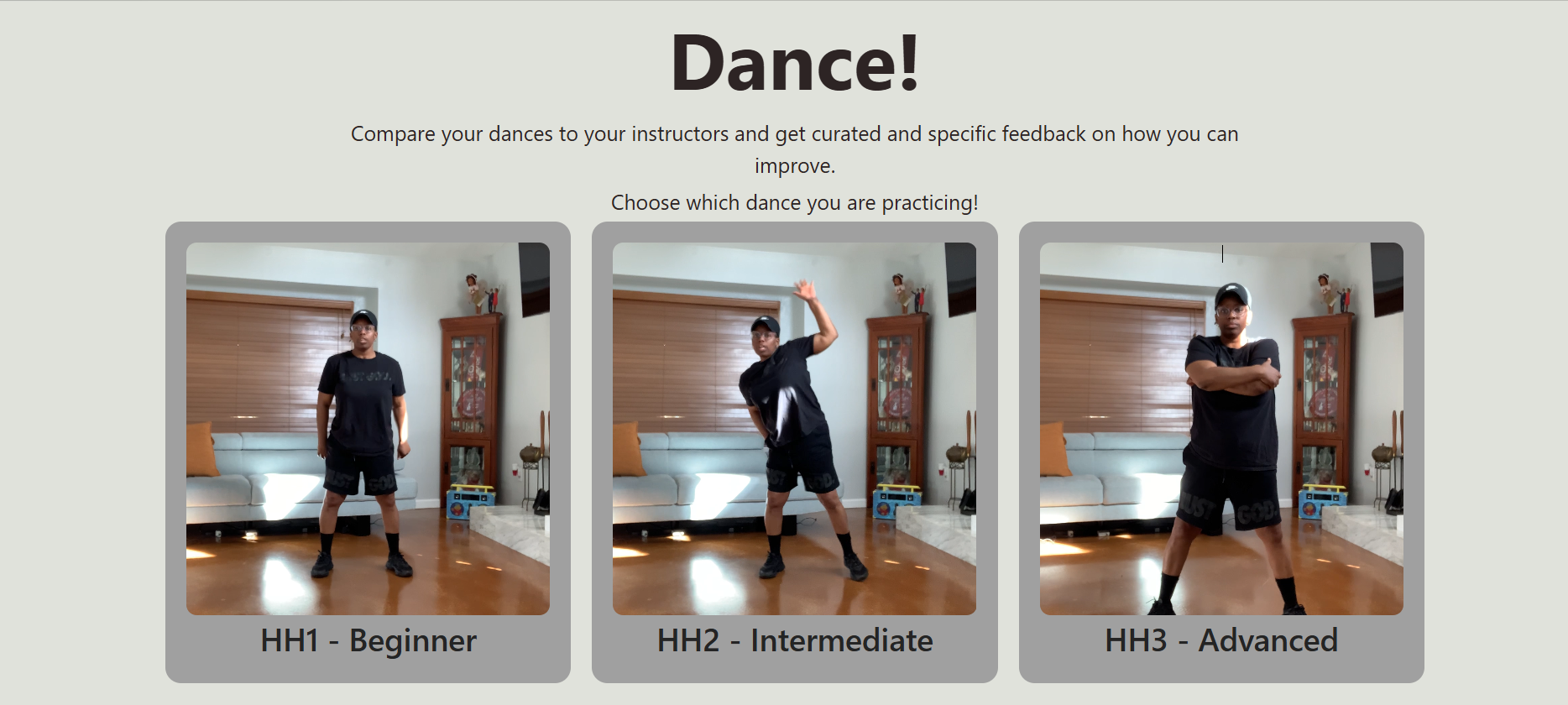
The project has successfully produced a functional web-based prototype that allows users to select routines, upload videos, and receive side-by-side visual feedback with dynamic accuracy scores. Key technical accomplishments include the integration of a pose-matching pipeline that successfully correlates algorithmic scoring with professional "ground truth" evaluations from dance faculty. Deliverables include a polished frontend interface, a backend processing engine that runs locally with a low memory footprint, and a validated similarity metric that currently averages a 14.76% error rate compared to human judgment. By the project's conclusion, the team aims to further refine this scoring system to reach within ±5% of instructor evaluations.