
Wildfires pose a significant threat to ecosystems, infrastructure, and public safety, creating a need for faster and more reliable detection systems. This project develops a collaborative edge–cloud architecture that integrates environmental sensors, UAV imagery, and machine learning models to detect wildfire ignition early. Edge-based models provide fast, low-power detection, while cloud-based models verify events using high-accuracy image analysis. This system improves detection speed, reduces false alarms, and enables monitoring in remote or resource-limited environments.
EECS
2025-2026
Winter
Internally Mentored (faculty, staff, TA)
Collaborative Edge–Cloud Machine Learning for Wildfire Detection
Summary
Technical Approach/Methodology
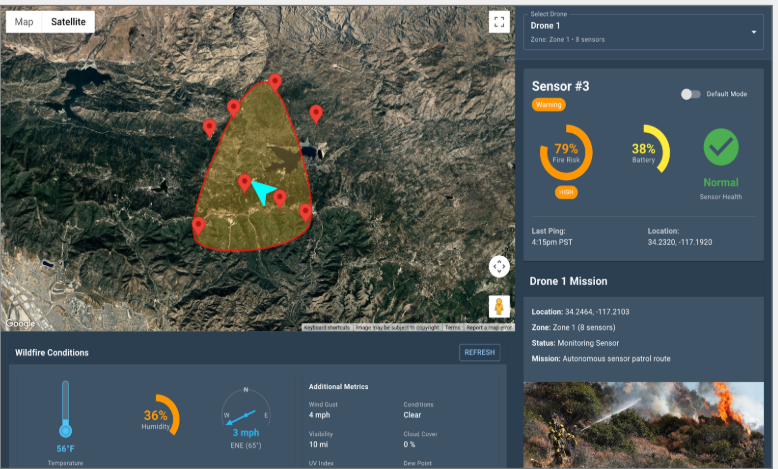
The system combines two machine learning approaches: a Random Forest model running on edge sensor nodes and a Convolutional Neural Network (CNN) processing UAV imagery in the cloud. Sensor data such as temperature, humidity, and wind conditions are used for real-time risk prediction, while aerial images are analyzed for fire and smoke detection. A Radial Basis Function (RBF) interpolation model converts discrete sensor outputs into a continuous wildfire risk map. The results are visualized through an interactive dashboard integrating geospatial data and real-time analytics.
Outcomes
The project successfully developed a real-time wildfire monitoring dashboard and trained two complementary machine learning models for detection. The CNN model achieved high accuracy in identifying fire events from aerial imagery, while the edge-based Random Forest model provided reliable environmental risk predictions. Additionally, the system implemented dynamic spatial mapping to track fire spread and boundaries. Overall, the project demonstrates a scalable and efficient wildfire detection framework combining edge intelligence and cloud computing.
Project Media
Project Video
Project Poster