
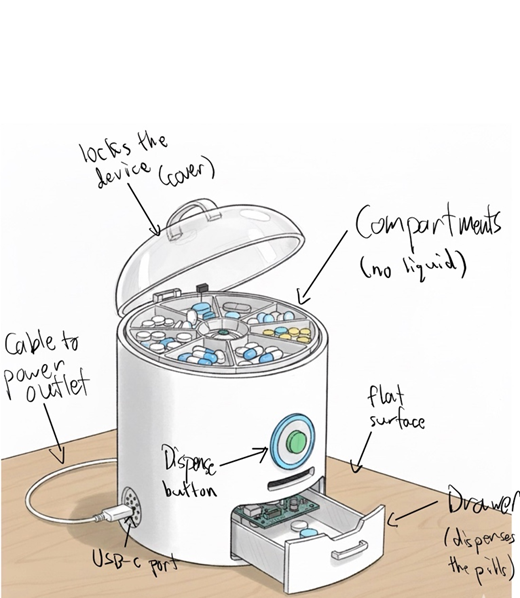
Auto-Pill Dispenser was developed to address the problem of medication non-adherence among elderly and disabled patients who may forget doses, take the wrong quantity, or rely on caregivers for daily medication management. Traditional pill organizers still require manual sorting and tracking, while many existing automated dispensers are too expensive for widespread use. This project proposes a low-cost smart dispensing system that combines a 3D-printed mechanical design, embedded control, sensors, and a web interface to automate scheduled medication delivery. The project matters because missed or incorrect doses can seriously affect patient health, and the people most affected are seniors, individuals with chronic health conditions, and caregivers who need a more reliable and affordable medication management tool.
AutoPill Dispenser
Summary
Technical Approach/Methodology
The Auto-Pill Dispenser addresses medication non-adherence by combining a 3D-printed dispensing mechanism with an embedded control system and a web-based scheduling interface. A Raspberry Pi 5 controls a servo motor to release medication at programmed times, while an infrared sensor detects whether pills pass through the dispensing channel. The system also uses a web application built with React Native, Go, and SQLite so that patients or caregivers can set schedules and manage medication data more easily. Together, these components create a low-cost prototype that automates dispensing, improves reliability, and reduces the need for constant manual supervision.
Outcomes
By the end of the project, we produced a working Auto-Pill Dispenser prototype that combines a 3D-printed dispensing mechanism, embedded control system, infrared pill detection, and a web-based scheduling interface. In addition to the components described in the report, we also built a cardboard outer enclosure to house and support the integrated prototype during testing. The final control program was completed so that the system could continue actuating the dispensing mechanism when no pill-drop event was detected and stop once a successful drop was confirmed by the sensor. Overall, the project delivered a functional low-cost prototype, a complete software-hardware workflow, and a tested proof of concept for automated medication dispensing.