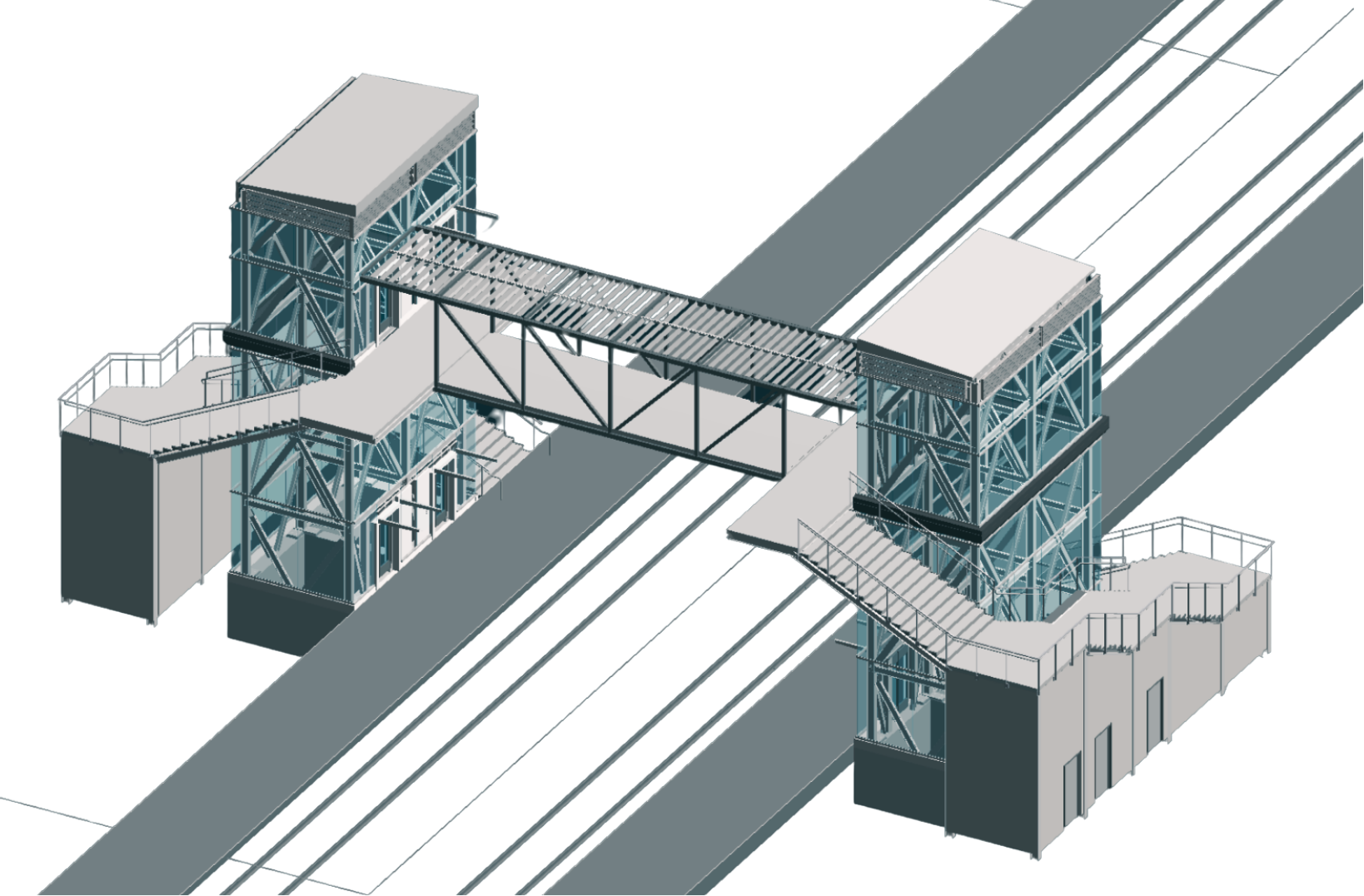
Students performed sizing designs of all major steel members, concrete decking, a preliminary concrete shear wall design, and preliminary base plate design. Students created a digital 3D model in Revit to visualize these structural components within the architectural facade, station platform, and rails.
The bridge structure features a modified Pratt truss to evenly distribute gravity and lateral forces to the symmetrical elevator towers on either end of the bridge. The bridge is framed with exposed, square steel members and covered with glass panels to match local aesthetics. The deck of the bridge utilizes a crowned concrete and metal deck that prevents the accumulation of water on the walking surface to conform to ADA guidelines. At the connection between the bridge and elevator towers are elastomeric polymer bearing pads that allow for thermal expansion and contraction as the bridge heats and cools, as well as movement during seismic or wind events.
The elevator towers feature multi-tiered ordinary concentric braced frames, likewise made of square steel members and covered with glass panels, and walking surfaces use concrete and metal decking furnished with handrails. The elevator towers support the weight of the bridge, and both the bridge and towers sit on concrete shear walls. Students prepared conceptual details for the concentric braced frame connections, moment frame connections, base plate, and concrete shear walls.
The stair structures feature multi-tiered ordinary concentric braced frames as well as diagonal bracing to meet structural requirements within architectural constraints. The stairway structure is laterally detached from the elevator tower using a slip-connection located at the bottom of the highest set of stairs. The stairs rest on pedestals, and both the concrete shear wall and the pedestals rest on a mat foundation that supports the entire station structure. Students prepared a conceptual detail for the slip-connection.