
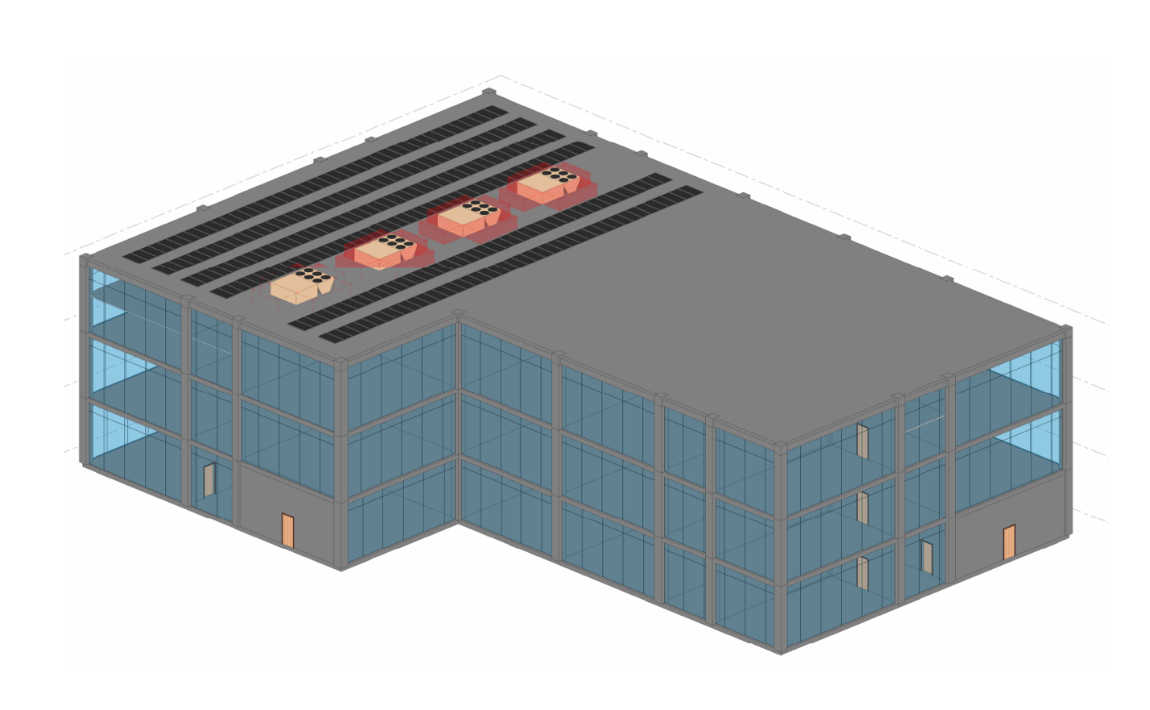
The capstone design project involves the creation of a schematic design for a three story school building to be built on the UCI Campus. The team was hired to design gravity and seismic structural components for this three-story building based on Architectural constraints. By following ASCE 7-22 and ACI 318-25 building codes, and using steel specifications from AISC 360-22 and 341-22, the building was designed as a steel structure, with steel decking on the roof level, and a composite beam with concrete-filled decking on the 2nd and 3rd stories. The framing of the entire structure was built using A992 steel with a strength of 50 ksi. The building is designed with isolated concrete spread footings. All concrete elements of the building consist of normal-weight concrete with a strength of 3 ksi. For its Lateral Force Resisting System, Special Moment Frames were designed with pre-qualified Side Plate connections. Seismic resistance controls were completed using response spectral analysis conducted through an ETABS modeled analytical model. All structural and architectural renderings were completed using CAD programs, including Revit and AutoCAD. Further project considerations included cost estimates for the project and the potential carbon footprint of the designed building. The goal of the project is to ultimately present a schematic structural design, including engineering calculations, member schedules, and renderings, to be presented to the client of the project.
Three Story School Building Design
Summary
Technical Approach/Methodology
The design approach was split into two major components. The first component was sizing and designing structural members for gravity loading designated for the building. This included finding and assigning the proper loading depending on the purpose of the structure that is designed, and the types of structural and architectural materials used for the design of the building. Starting with the horizontal beam members. For the higher loads found on the third and second stories, it was deemed favourable to use composite beams, allowing for greater spans, without the need for close-spaced columns. This allows for spacious classrooms, keeping in mind an architectural consideration for the project. Given the smaller loading demand for the roof, it is more economical to stick to regular steel beams, holding up steel decking. Keeping in mind the ceiling height of 12 feet for each story, the target was to restrict the sizing of our beams to be no greater than 2 feet in depth. Allowing a spacing of at least 3 feet for HVAC, given the height of each story is 15 feet. This restricted our W member size selection to a maximum depth of W24.
The second major component of our structural design was the design of seismic load-resisting systems. Given the requirement of having glass cladding for the entire perimeter of the building, the design was restricted to choosing Special Moment Frames for the LFRS of the structure. Keeping in mind the redundancy and symmetry of these systems within the building, despite the non-symmetrical L-shape, the location of SMF was carefully selected for the building. With a linear dynamic analysis conducted to determine the Base shear and lateral loads at each level, the goal was to effectively extend the fundamental Period of the building and utilize the ductility of the steel members, which reduces the stiffness, as the members can be sized to resist a smaller Base Shear. Seismic drift and torsional checks were completed to ensure that this increase in structural ductility does not compromise seismic requirements set by the ASCE 7-22 building code. To ensure the stiffness and strength of column and beam connections of our LFRS, SidePlate connections were selected and fitted for the lateral load resisting members of the structure.
After sizing all gravity and lateral force resisting systems, a cost estimate and carbon embodiment estimates are created for the client to determine the economic and environmental feasibility of the project, and consider possible alternatives, also presented through the schematic structural design of this project.
Outcomes
The structural blueprint for this 3-story classroom building incorporates and designs the primary components necessary to withstand gravity and seismic forces. Specifically, the resulting structure included both gravity and seismic load-resisting systems, including composite flooring systems, a steel roof structure, isolated spread footings, and Special Moment Frames with SidePlate connections to meet seismic design requirements. The building had floors spanning about 17000 ft2, with a total building area of 51,000 ft2. Using ASTM 992 steel and normal weight concrete, the framing and footings were made to standard. The ASCE 7-22 and ACI 318-19 were referenced for code compliance. For specific steel specifications of steel and seismic provisions, AISC 360 and AISC 341 were referenced respectively. For reinforcements, the diaphragm rebar is ASTM A615 grade 60 and the foundation is ASTM A706 grade 60. The applied mechanical area has a load of 50 psf over 3500 ft2, which was then spread out across the roof area. Live loads for the floor referenced the CBC-22 as per their designated room type. ELF calculations and response spectrum analysis supported the proposed structure design and met the relevant requirements. Structural and seismic checks were promptly performed for the strength, stiffness, drift, and stability of the overall building and its members. For the iterative process, structural analysis tools such as RISA3D for gravity members and ETABS for the seismic components were utilized. After all structural components were designed, a comprehensive calculation of material costs and its impact on the environment via carbon embodiment was performed.
From an engineering standpoint, the main goal of this project was to strike a balance between structural efficiency and constructability while considering architectural demands. Therefore, simplification of some parts of the initial layout while retaining its essence allowed focusing solely on engineering aspects. Moreover, collaboration with industry professionals and university professors helped gain an understanding of different approaches to structural engineering, as well as the software and design processes used in actual construction projects. This led to a constructive learning experience for the team and developing the proper design philosophies required of structural engineers.