
The interchange between Ortega Highway (SR-74) and I-5 in San Juan Capistrano has long experienced operational and geometric deficiencies, with documented issues dating back to 2006. The existing facility includes substandard 10-11 ft travel lanes, missing shoulders on SR-74, limited spacing between ramp terminals and nearby intersections, and recurring queue spillbacks that exceed available storage capacity. As a result, the interchange currently operates at Level of Service (LOS) F during both peak periods, with conditions expected to worsen under a no-build scenario. The project is further constrained by its surrounding environment, including San Juan Elementary School, Old Mission Cemetery, Horno Creek, and the historic Mission San Juan Capistrano. These features significantly limit available right-of-way (ROW) and restrict alignment and grading options, making improvements both necessary and complex. The project primarily serves commuters, local residents, and regional freight traffic using SR-74 and I-5.
Ortega Highway & I-5 Interchange Improvement: Redesign and Feasibility Analysis of San Juan Capistrano's Compact & High-Volume Interchange
Summary
Technical Approach/Methodology
To address these issues, multiple interchange configurations were developed and evaluated using a weighted decision matrix considering safety, operational performance, structural cost, ROW impacts, and environmental sensitivity. Five alternatives were analyzed in total, with several eliminated due to cemetery encroachment, inadequate weaving distance, or missing traffic movements. Traffic operations were modeled to evaluate intersection performance under existing and future conditions, with particular focus on ramp junctions and coordination with adjacent intersections. Design standards from Caltrans Highway Design Manual (HDM) were applied to ensure compliance with lane widths, sight distance, and vehicle accommodation requirements. Environmental and permitting considerations were integrated into the design process, including coordination with CDFW, USACE, RWQCB, and NPDES requirements. Construction staging and utility relocation planning were also incorporated to ensure traffic continuity during construction.
Outcomes
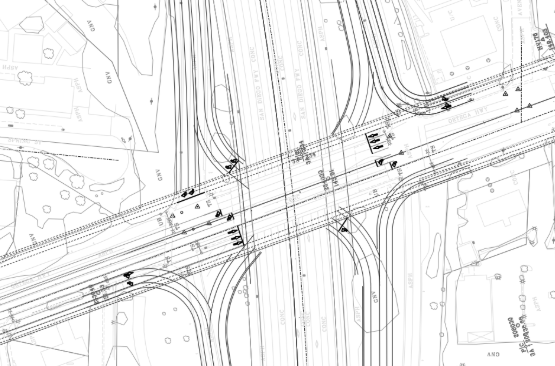
The selected alternative is a Single Point Urban Interchange (SPUI), which achieved the highest overall weighted score (67 compared to 61 for the Diverging Diamond Interchange). The SPUI consolidates all turning movements into a single signalized intersection, improving operational efficiency and reducing conflict points. Traffic modeling projects an improvement from LOS F to LOS C at the critical ramp intersection under this design. Key design elements include upgraded 12 ft lane widths, addition of shoulders and sidewalks, improved intersection spacing, and accommodation of WB-67 design vehicles through widened lanes and truck aprons. The SR-74 bridge consists of a 226 ft cast-in-place concrete box girder structure with a 144 ft width, designed to meet Caltrans standards and future freeway clearance requirements. Retaining walls minimize grading impacts and reduce ROW acquisition to approximately 8,366 sq ft across three parcels. Environmental compliance measures include creek protection and habitat restoration for Horno Creek, along with required federal and state permitting. The project also includes a two-year phased construction staging plan, utility relocation coordination, detour planning, and public outreach strategy to maintain mobility and community engagement. The total estimated project cost ranges from $65–90 million, covering construction, utilities, ROW acquisition, and traffic management. Remaining design work includes final grading plans, retaining wall detailing, sight distance verification, and striping and lane transition design.