Internal (faculty, staff, TA)
EECS
2025-2026
Fall
Winter

Light Show Drones

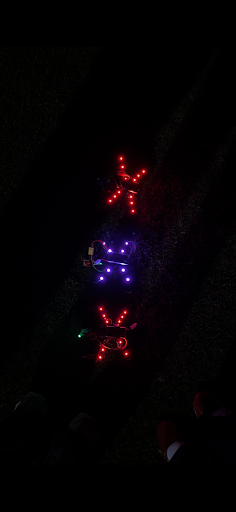
Image showing 3 Light Show Drones

Summary

The Light Show Drones project was developed as an affordable and environmentally friendly entertainment system for personal events and small gatherings. The system consists of three drones that perform synchronized light displays and simple autonomous flight maneuvers, providing an engaging visual experience while remaining easy to operate for users with little or no prior drone experience.

Each drone was custom-built using a MOD-L frame, a Matek F405-WMN flight controller, T-Motor F1404 3800KV motors, and a Raspberry Pi Zero W co-processor. The Raspberry Pi runs Python-based software that coordinates flight operations and controls the attached WS2812B RGB LED strips. Navigation is supported by BE-880 GPS modules, while communication is handled through 2.4 GHz Wi-Fi for telemetry and 802.15.4 wireless links for rapid light-control signaling. The total replication cost for each drone was kept below $700.

Testing showed that the drones could maintain autonomous hovering within a 0.5-meter radius and successfully complete a 120-second coordinated light show synchronized to the song "Cha Cha Slide." During the performance, the drones executed six programmed color transitions with synchronization accuracy within 0.1 seconds across the fleet.

Technical Approach/Methodology

The Light Show Drones project uses a hardware-software design that combines a fleet of three custom-built drones with a centralized synchronization system. Each drone is built on a MOD-L frame and uses a Matek F405-WMN flight controller for flight stabilization along with T-Motor F1404 3800KV motors for propulsion. A Raspberry Pi Zero W is installed on each drone to handle lighting control and synchronization tasks, reducing the computational load on the flight controller. Communication between the Raspberry Pi and flight controller is performed using the MAVLink protocol.

WS2812B addressable RGB LED strips are mounted to each drone to create the light displays. The LEDs are powered by a separate 5V supply to prevent voltage fluctuations from affecting the flight electronics. Positioning and navigation are provided by BE-880 GPS modules, which allow the drones to maintain autonomous hovering within a 0.5-meter radius under normal operating conditions.

Wireless communication is divided between two networks. Telemetry and flight data are transmitted over a 2.4 GHz Wi-Fi connection based on the IEEE 802.11b standard, while lighting synchronization signals are sent using IEEE 802.15.4 communication to reduce latency and network traffic. A Python-based synchronization program coordinates both the lighting effects and flight paths for the three drones. Using this approach, the fleet can perform synchronized flight routines and color transitions with timing differences of less than 0.1 seconds. The system was used to execute a 120-second autonomous light show synchronized to an external audio track.

Outcomes

The Light Show Drones project demonstrated the successful implementation of a coordinated autonomous aerial performance system. During testing, the navigation system met its design requirements by maintaining autonomous hover stability within a 0.5-meter radius. The communication architecture and synchronization software also performed as intended, allowing the LED systems on all three drones to execute programmed color transitions with timing differences of less than 0.1 seconds.

These capabilities were demonstrated through a 120-second autonomous flight routine synchronized to the song "Cha Cha Slide." Throughout the performance, the drones completed multiple programmed formation changes and six coordinated color transitions while maintaining synchronization across the fleet.

Project Media

Project Poster