CEE
2025-2026
Winter
Spring
Industry Sponsored

Hillside Land Development Senior Design Project

Carbon Canyon Road Development Icon

Summary

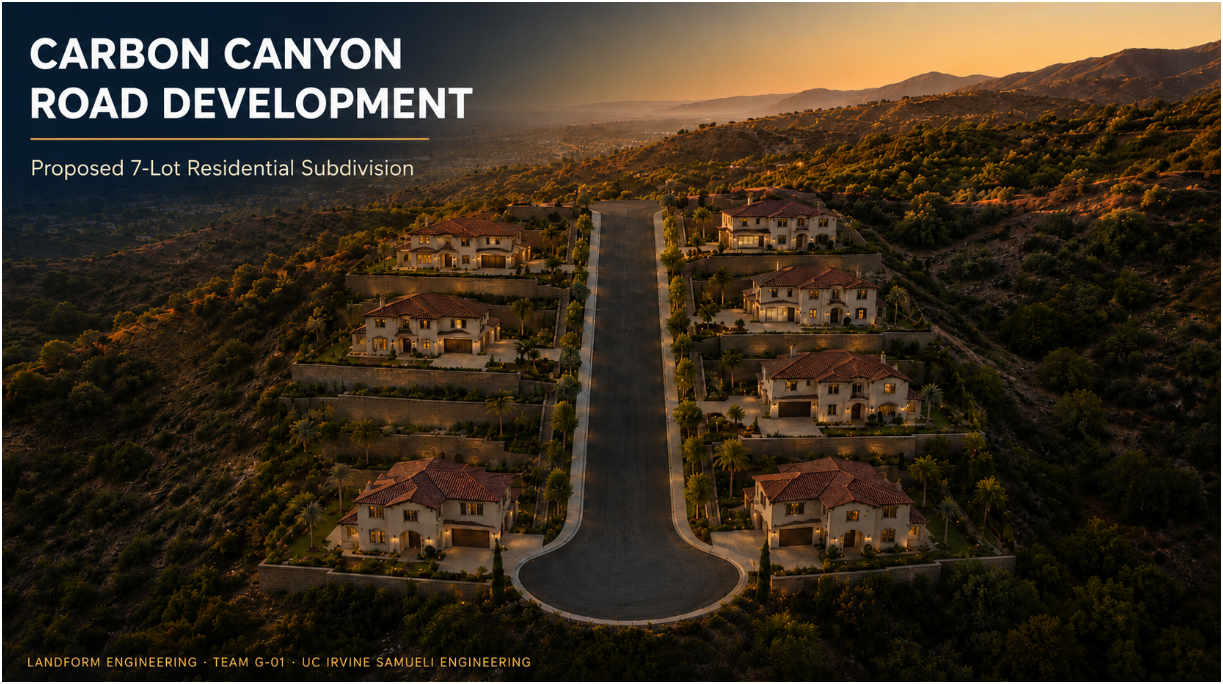
Our project takes a vacant 3.38-acre hillside parcel at 5800 Carbon Canyon Road in Brea, developing the complete preliminary civil design needed to subdivide it into seven single-family lots. We covered street layout, grading, storm drainage, sewer, and water. The site has sat undeveloped for a reason, however. It carries 40 to 50 feet of elevation change, has a single feasible access point off Carbon Canyon Road, and every street and pipe built on it has to work with that slope. 


Parcels like this are increasingly what remains in north Orange County, where housing demand is strong: but flat, easily developed land is gone. The need we are addressing is practical. Our team wants to show that a steep infill site can support a code-compliant, financially realistic subdivision. 


The outcome affects future homeowners, the City of Brea, which would take on maintenance of the new public street and drainage, and neighbors along the Carbon Canyon corridor. Psomas, our industry advisor, structured the work to mirror professional land development practice, and the design is prepared to City of Brea plan-check standards.

Technical Approach/Methodology

We followed the same sequence a civil consulting firm would use on a land development job. The lot layout and street alignment came first, since everything else depends on where the road sits. From there we designed the vertical geometry, meaning how steeply the street climbs and where each building pad lands, then routed the storm drain, sewer, and water systems to serve every lot by gravity wherever possible. 


All plans were produced in AutoCAD Civil 3D, which also generated earthwork volumes from the existing and proposed ground surfaces. Stormwater was sized with the Rational Method, a standard formula that estimates peak runoff from rainfall intensity and drainage area, and pipe capacity was checked with Manning's equation. 


Design criteria came from City of Brea standard plans, Orange County Public Works standards, the Greenbook construction specifications, and the Caltrans Highway Design Manual for sight distance. Before committing to a layout we developed and compared three alternatives, then carried the strongest one, a single public cul-de-sac, through full design and a cost estimate built from quantity takeoffs.

Outcomes

The team delivered a full preliminary design package, assembled to the standard the City of Brea expects at plan-check submittal. The selected design fits seven conforming R-1 lots between 0.46 and 0.50 acre, served by Olinda Drive, a new public cul-de-sac in a 56-foot right-of-way. Specific deliverables:

  • Final Design Report covering goals, constraints, alternatives analysis, regulatory and environmental requirements, and recommendations
  • Four-sheet plan set: site plan, street plan and profile, grading plan, and utility plan
  • Hydrology and hydraulic calculations, earthwork volumes, and utility sizing
  • Opinion of probable construction cost totaling $812,940, roughly $116,000 per lot, with a construction schedule

Just as important, the analysis surfaced the two issues that will govern final design. The street profile reaches a 16% grade on its steepest run, above the usual 10 to 12% ceiling for residential streets, and the site requires about 3,370 cubic yards of imported fill. Both are documented with recommended next steps, including a geotechnical investigation and field verification of existing utility connections.

Project Media

Project Poster