
The job of an engineer is to solve problems that occur within society whilst minimizing costs and maximizing the efficiency, safety, and applicability of their solutions. Where most other design projects aim to solve quantifiable problems, our project aims to expand engineering by working to solve the growing problem of fleeting creativity and joy through an artistic approach in addition to rigorous engineering analysis. In the digital era, screens and passive consumption dominate our attention, defining a societal need for tangible, interactive experiences that reconnect people with their sense of wonder. The High-Tech Art Exhibit aims to reframe the UC Irvine community's view of engineering as more than sterile technology and profit, instead focusing on the inherent creativity and joy that is deeply embedded within the design process itself.
High Tech Art Exhibit - The Interactive World of Anteaters
Summary
Technical Approach/Methodology
At its core, the project conceals an UNO R3 microcontroller controlling a precision-driven XY gantry system beneath a diorama of UC Irvine's campus. The position of the gantry is continuously tracked through the steps of stepper motors, triggering dynamic, reactive mechanisms from the miniature campus buildings as a figurine moves across the landscape. The engineering components are deliberately hidden from view, and instructions are intentionally withheld to encourage curiosity and organic exploration. The project is built on proven, industry standard technology, making the system reliable, maintainable, and reproducible, while keeping the barrier to long-term servicing and repair low. The project is also designed with customization as a foundational principle, with architecture that supports interchangeable dioramas, allowing entirely different artistic environments to be displayed and explored depending on venue and audience. 3D Printing and Arduino coding libraries were key in creating the exhibit within a respectable timeframe and budget. Thanks to the simplicity of the stepper motor coordinate system, the physical footprint of the exhibit can be scaled up or down with only minor adjustments to the code and changes in power, requiring no fundamental redesign of the underlying mechanics.
Outcomes
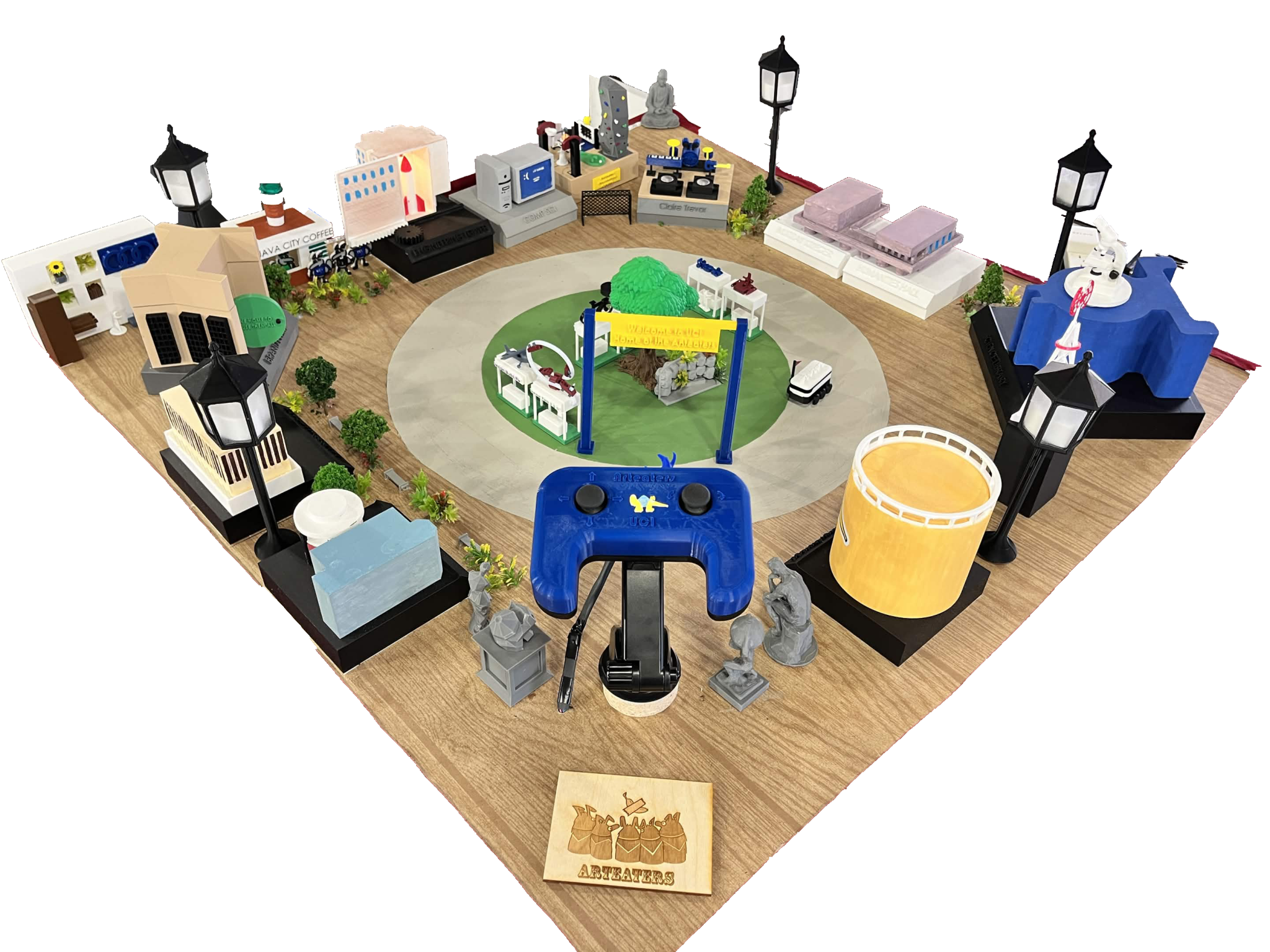
The exhibit is comprised of a dual-layered system: first, is the miniature artistic diorama of UC Irvine's campus containing the play-space for the user to explore and interact with actuated buildings and objects. It features a 40 inch x 40 inch visible environment, with 14 3D printed interpretations of UC Irvine buildings (six of which are interactive), three free-moving objects for the user's figurine to play with, and the controller for the user to enable movement of the figurine. Speakers and LED lighting are also built into the environment, interacting with additional senses during use. The second layer is hidden beneath the diorama, and houses the carriage for the XY gantry, UNO R3 microcontroller, wiring to diorama layer, and power adapters and plugs behind a red drape.
The project saw positive reviews with users rating their experience an average of 4.66 out of five stars on our user feedback forms, with the majority noting that they would return to use the exhibit again. The positive feedback and user experience's mark the project a success in evoking joy, and the user's interest in repeated experiences with the exhibit additionally denotes success in sparking creativity. Upon display of the project at the UC Irvine Annual Design Review project fair, the exhibit saw an average idle time of less than two minutes over the span of three hours, and encountered zero technical difficulties during that time as well.