
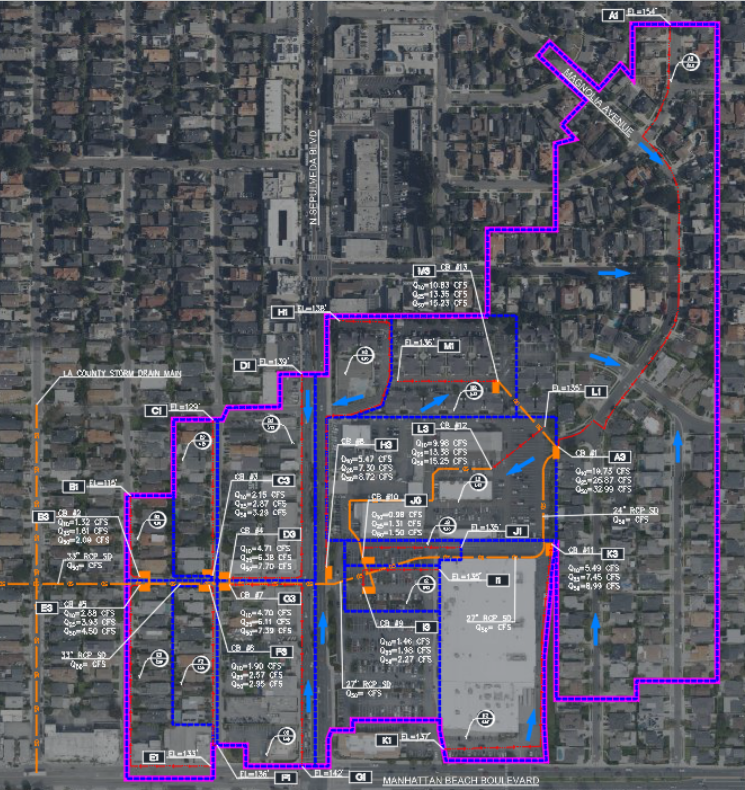
A hydrology study is performed in accordance with the Los Angeles County Hydrology Manual Standards for the hydraulic analysis of the existing catch basin located at 14th & Magnolia in Manhattan Beach, CA. The city has experienced frequent flooding in the area and would like to identify the deficiencies in the storm drain system. The study is to recommend improvements to address the frequent flooding that occurs.
CEE
2025-2026
Winter
Spring
Industry Sponsored
Here's the Catch
Summary
Technical Approach/Methodology
The project team evaluated flooding conditions at the 14th Street and Magnolia Avenue catch basin using a combination of hydrologic and hydraulic modeling tools. Watershed characteristics, including drainage area, flow path length, slope, and percent impervious surface, were analyzed to estimate runoff for the 10-, 25-, and 50-year storm events using HydroCalc. Surface flow conditions and catch basin performance were evaluated using Hydraulic Toolbox to assess roadway flooding and inlet capacity. The underground storm drain network was then modeled in Water Surface Pressure Gradient (WSPG) software to analyze hydraulic grade line behavior and identify system surcharging. Alternative pipe diameters were evaluated to determine the capacity required to eliminate surcharge conditions. Based on the hydraulic analysis, constructability constraints, and cost considerations, a Permavoid underground detention system was developed as the recommended solution. AutoCAD was used to prepare construction drawings and site layouts for the proposed improvements.
Outcomes
The project resulted in a comprehensive evaluation of flooding conditions at the 14th Street and Magnolia Avenue catch basin in Manhattan Beach, California. Hydrologic and hydraulic analyses identified deficiencies in both the existing catch basin and the underground storm drain system, with WSPG modeling showing surcharge conditions during design storm events. Alternative pipe sizes were evaluated, and results indicated that a 42-inch storm drain would be required to eliminate surcharging during larger storm events. However, due to significant construction, permitting, and cost constraints, full pipe replacement was determined to be impractical. The team developed a recommended solution consisting of an expanded catch basin and a Permavoid underground detention system capable of providing approximately 6,800 cubic feet of stormwater storage. Final deliverables included a hydrology report, hydraulic modeling results, cost analysis, and construction drawings for the proposed improvements.
Project Media
Project Poster