
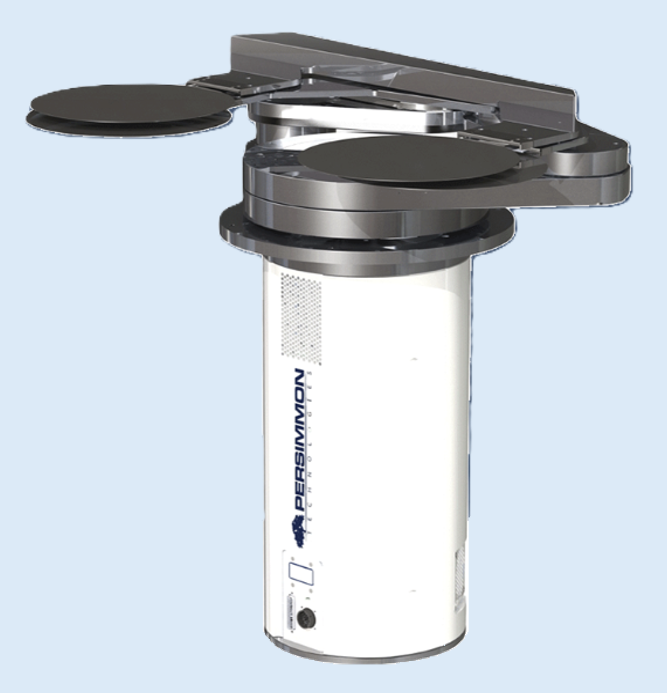
Vacuum robotics used for high-precision chip handling requires materials that minimize vibration and settling time without sacrificing stiffness or compatibility with high-vacuum environments. This project investigates high-damping aluminum-based material solutions for Persimmon Technologies’ robotic arms to improve dynamic performance beyond the current Aluminum 6061 design baseline. Improvements would decrease cycle time, leading to better productivity. Three candidate pathways were evaluated: aluminum metal matrix composites, additively manufactured lattice structures, and cold-spray processing. Cantilever damping tests, tensile testing, three-point bend testing, and scanning electron microscopy were used to compare damping ratio, natural frequency, stiffness, and microstructure across the sample sets. Initial results show that damping behavior depends strongly on microstructure and fabrication route, with cast A356 aluminum alloy outperforming baseline 6061 in damping, while the fly-ash composite underperformed expectations. Ongoing work focuses on identifying the most promising material architecture for maximizing damping while maintaining the mechanical performance required for robotic arm operation in a high-vacuum environment. This research may be useful in other applications, namely automation, marine technologies, aerospace, and medical devices. Anything that requires improvement in audible or mechanical stability will benefit from this work.
HDAC - High Damping Aluminum Composites
Summary
Technical Approach/Methodology
To fabricate a high-damping aluminum composite, both compositional modifications and structural design strategies can be investigated. This project is split into three pathways: metal matrix composite, metamaterial lattice, and cold spray samples to optimize damping. Each pathway involves a unique manufacturing process. This can create different types of stresses in the material, affecting the damping capacity. To manufacture the metal matrix composite (MMC), a combination of ceramic oxide powders known as fly ash was mixed into molten A356 aluminum alloy and sand cast. After casting, the test sample is milled to the appropriate dimensions and tested for its damping capacity. There were multiple baselines for comparison of the metal matrix composite, including 99.7% pure aluminum, Aluminum 7075, and A356. These were sand cast and processed in the same way as the MMC. The metamaterial lattice specimen was manufactured through selective laser melting (SLM) metal printing. Its unit cell, building block, was a face and body centered cubic with vertical axis struts (FBCCZ), that was patterned to the required printing dimensions. Afterwards, the samples were cut from their build plate by electrical discharge machining (EDM) and tested for their damping capacity. Finally, Aluminum 6061 powder was cold-sprayed–shot at a 3 times the speed of sound–at a plate and then removed with EDM before being tested.
Outcomes
To date, the project has produced several key deliverables, including fabricated aluminum samples, damping ratio datasets, and mechanical property analyses. Preliminary results demonstrated that reference materials such as A356 and 99.7% pure aluminum exhibited the highest damping ratios. By comparing the damping ratios obtained, the team investigated how each manufacturing process influences the damping behavior of the materials. It was the team’s goal to provide the industry company with a means to continue this research. Additionally, an evaluation of manufacturing cost and scalability was conducted alongside the material’s damping performance, given the intended application in precision robotics.