Industry Sponsored
MSE
2025-2026
Fall
Winter
Spring

The Future of Plasma Vapor Deposition

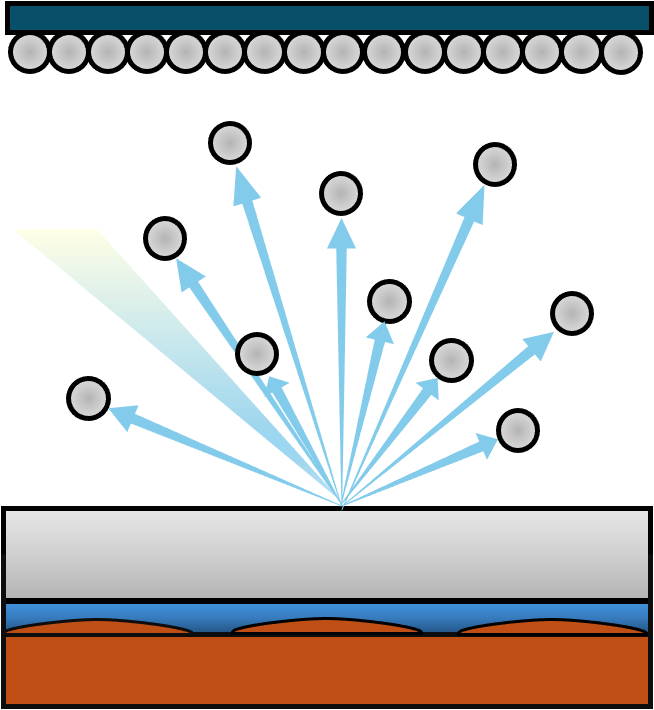
PVD Assembly for Coatings

Summary

Plasma Vapor Deposition (PVD) is a technique used for applying thin coatings on applications such as door knobs, drill bits, and decorative plating on phones and watches. The target material that creates the coating is connected to a conductive backing plate by a bonding layer. In order to deposit and sputter the material to create a film, the target material is heated in an electric field to move atoms of the target onto the desired material. Because heating makes it easier to remove atoms from the target material, the deposition rate is therefore limited by the melting temperature of each layer. Indium is traditionally used as a bonding layer, and compared to the other layers has the lowest melting temperature of 156°C. 

To improve upon the current bonding layer and ultimately decrease the processing time of PVD, a new alloy must maintain the thermal conductivity and softness of Indium, while simultaneously increasing the melting temperature. This project investigates a new alloy composition to meet these requirements, resulting in faster processing speeds and greater efficiency with PVD systems, and therefore more throughput for PVD thin films and coatings.

Technical Approach/Methodology

First, elements are down selected based on thermal conductivity, with expensive, reactive, and/or toxic elements discarded. The resulting favorable elements include silver, copper, indium, tin, aluminum, and zinc. Elements were paired and evaluated as alloy systems, selecting for theoretical strength, melting point, phase stability, and lack of intermetallics. Two primary candidates evaluated were a copper-indium alloy (70 at% Cu) and a silver-tin alloy (80 at% Sn). 

Samples were alloyed in a box furnace and sand-casted, followed by subsequent heat treating for more homogeneous distribution and relieve internal stresses. Each sample was tested for its thermal conductivity, melting point, and yield strength. These alloy properties were compared against a pure tin benchmark, which serves as a reference for the experiment. Tin is an alternative to indium that possesses a higher melting point but has unfavorable thermal conductivity and yield strength.

For thermal properties, thermal conductivity is measured electrical conductivity, which would be done through four-probe cyclic voltammetry. Thermal conductivity is important for the bonding layer to conduct heat from the sputtered layer to the backing plate. Melting temperature is determined through differential scanning calorimetry (DSC). 

For physical properties, alloy yield strength is measured through compression testing. The bonding layer would be ideally soft to absorb energy from bombardment through plastic deformation. Elemental composition is verified through energy dispersive spectroscopy (EDS), with grain size distribution estimated via scanning electron microscopy (SEM). Elemental composition is important as composition may vary during casting, and grain size comparisons help with describing the phase structure of our alloys. 

Outcomes

By the end of the project, the melting temperature, electrical conductivity, and yield strength of the synthesized alloys will be determined. The results will inform whether silver-tin and copper-indium at the tested compositions can be recommended for target bonding. Deliverables include characterization data, including final compositions, as well as physical samples of the alloys. More specifically, DSC data will display the melting point, stress strain curves from compression testing will display the yield strength, and a 4-probe test will display the electrical conductivity values. Additional data includes SEM-EDS to confirm alloy composition, XRD spectra of the copper indium to verify phase formation, and SEM micrographs to qualitatively assess the microstructure. 

Project Media

Project Poster