
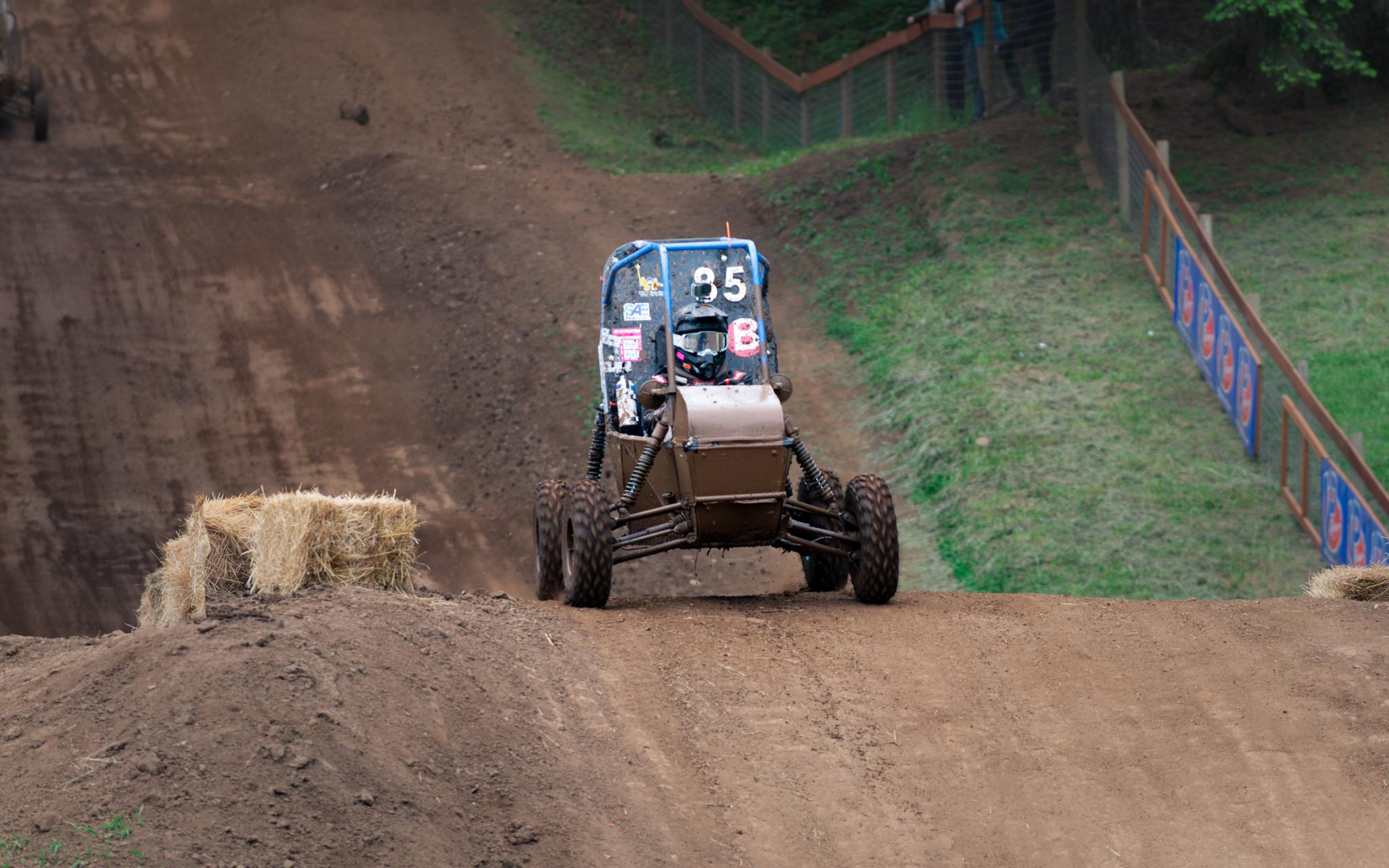
The UCI Anteater Baja Racing (ABR) team designs, builds, and races an off-road vehicle each year in the SAE Baja intercollegiate competition. A six-person capstone sub-team sponsored by Cortek and T-Slots designed, fabricated, and validated a Driveline Test Bench (DTB) to experimentally characterize how driveshaft angle affects power transmission, vibration, and rotational speed through the vehicle's U-joints. The problem this addresses is real: driveline geometry is one of the most consequential packaging decisions in a Baja vehicle, yet ABR had no controlled way to measure its effects without expensive, time-consuming desert test days. The DTB provides a repeatable, lab-based platform for generating the data needed to inform setup decisions for ABR's next competition vehicle, Spectre, and for future teams going forward.
Anteater Baja Racing Driveline Angle Test Bench
Summary
Technical Approach/Methodology
The bench is built on a T-slot aluminum extrusion frame, chosen for its modularity and future adaptability. A 1800W VEVOR electric motor drives the driveshaft at controlled RPMs via a DC power supply, with a tachometer providing real-time speed feedback. A sliding differential mount allows driveshaft angle to be set from 0° to 12° without disassembly; an adjustability feature added in response to faculty feedback. Data acquisition runs on an Arduino microcontroller paired with an MPU-6050 three-axis accelerometer and a Hall effect RPM sensor, with all readings timestamped and exported as CSV for post-processing in Python. Vibration response was analyzed using FFT to identify harmonic content, and structural natural frequencies of the bench were calculated and experimentally confirmed to sit outside the motor's 0–500 RPM operating range. Measurement uncertainty was characterized across repeated trials, and an FMEA was conducted to identify and mitigate the top failure risks before final testing.
Outcomes
The DTB was successfully designed, built, and validated. Key findings from final testing: the bench's structural natural frequencies (~10.3 Hz and ~23.4 Hz) lie outside the operating speed range, confirming the frame won't resonate during tests. FFT analysis of shaft harmonics showed a monotonic increase in vibration amplitude as U-joint angle increased from 0° to 12°, providing a clear, quantified relationship between driveline geometry and vibration, data that ABR's team can use directly in packaging decisions for Spectre. Measurement repeatability was characterized at ±8.9% CV. Deliverables include the fully functional test bench, a complete build book with operating procedures, a validated data acquisition system, and driveline layout recommendations for the next competition vehicle. The project also produced handoff documentation so future ABR capstone or club members can continue testing with no ramp-up time.