
Fuel Blending Systems Control and Demonstration
Summary
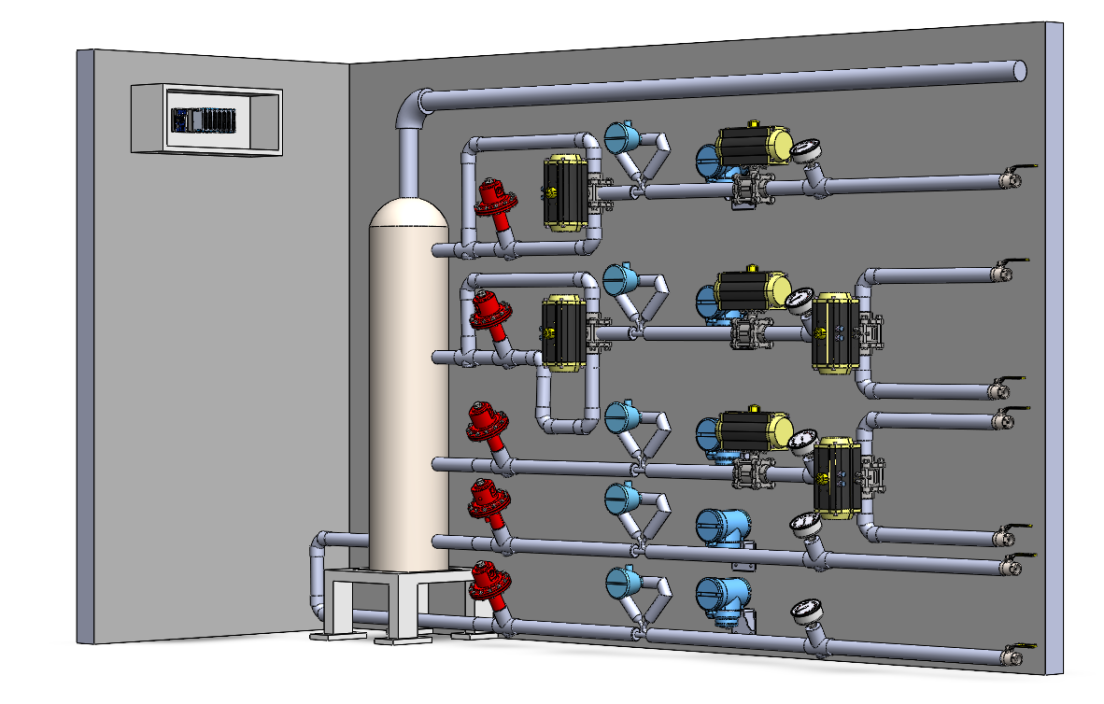
The Fuel Blending System Control and Demonstration project focuses on modernizing and integrating advanced control and data acquisition technologies for the UCI Combustion Lab’s fuel mixing system. This system supports testing on multiple end-use devices, including gas turbines, fuel cells, and other combustion systems, which are being adapted for operation on low-carbon fuels such as hydrogen and biogas. The project involves reviewing existing system components, developing a comprehensive bill of materials (BOM) for upgraded hardware and software (e.g., LabView, Python, or MATLAB-based control), and ensuring full system compatibility. Once the updated components are procured, the team will integrate and demonstrate the system’s performance on one or more devices. The project aims to enhance flexibility, reliability, and data quality in fuel blending operations, supporting ongoing research in hydrogen and low-carbon fuel applications.
Background
The UCI Combustion Lab conducts research on adapting various energy systems—such as gas turbine engines, fuel cells, water heaters, and stoves—to operate on low-carbon fuels like hydrogen. To support these efforts, the lab uses a versatile fuel blending system capable of producing customized fuel mixtures, including hydrogen/natural gas blends, syngas, and biogas. However, the current control and data acquisition systems are outdated and limit the precision, flexibility, and efficiency of testing operations. Upgrading the control software and hardware is essential to improve system reliability, enable advanced data collection, and support ongoing research into cleaner and more sustainable energy technologies.
Goal and Objectives
Our primary objective is to design and implement a modernized control system capable of efficiently and precisely blending at least three of the seven available gases—specifically natural gas, hydrogen, and nitrogen. Achieving this goal requires upgrading both the hardware and software components of the existing system.
- Implement improved data logging capabilities through MATLAB code for more comprehensive monitoring and analysis of system performance: November 18th, 2025
- Incorporating a Proportional-Integral-Derivative (PID) control strategy will significantly improve accuracy and responsiveness in gas flow regulation, ensuring consistent fuel mixture quality across a range of operating conditions: December 5th, 2025
- Integrate a new computer and updated Texas Instruments (TI) data acquisition modules to enhance processing speed, reliability, and compatibility with advanced control algorithms: March 13th, 2025
- Improve user interface and increase ease of access remotely: March 20th, 2025
Together, these improvements will create a robust, flexible, and scalable control platform for future low-carbon fuel research and demonstration.
Documentation
Some of our most recent presentations can be found below:
Team Contacts
- Mark Jiang - markyj@uci.edu
- Aman Shaik - abshaik@uci.edu
- Jackie Peng - jackip2@uci.edu
- Jonathan Ramos - jonather@uci.edu
Sponsors
- Professor Vince McDonell - mcdonell@ucicl.uci.edu
- Professor Mark Walter - m.walter@uci.edu
- Professor David Copp - dcopp@uci.edu